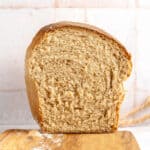
Whole Wheat Sandwich Bread
This recipe makes the best whole wheat sandwich bread that's soft but hearty enough for sandwiches and toast. It was a best seller at a Cafe I owned years ago. It can be made by hand or with a stand mixer. If you're apprehensive about using yeast, I share step-by-step photos and tips to guide you.
Servings 2 loaves
Ingredients
- 2 tablespoons active-dry yeast for other types, see Notes below
- ¼ teaspoon sugar to start the yeast
- 1 cup warm water
- 1 cup warm milk
- ½ cup honey
- 3 tablespoons soft butter
- 2 ½ cups whole wheat flour finely milled
- 1 tablespoon salt
- 1 egg at room temperature
- 3 ½ to 4 cups bread flour all-purpose can also work
Instructions
- In a small bowl, mix 1 cup warm water, 2 tablespoons active-dry yeast and ¼ teaspoon sugar and let it rest for 5 minutes.
- In another bowl, mix 1 cup warm milk, ½ cup honey and 3 tablespoons soft butter. The butter will not incorporate fully and that is fine.
- In the bowl of the stand mixer or a large bowl if making it by hand, combine 2 ½ cups whole wheat flour and 1 tablespoon salt.
- Add the milk mixture, 1 egg and yeast mixture to the flour mixture. Beat at medium speed for 3 minutes with the paddle attachment or mix with a wooden spoon or spatula by hand.
- Change to the dough hook attachment and add ½ cup of bread flour while mixing. If by hand, add ½ cup of flour at a time until too stiff to stir and transfer to a lightly floured counter and start kneading, incorporating the rest of the bread flour until you have a soft, supple dough. You might not use all of the bread flour.
- Beat at medium-high speed for about 5 minutes until the dough is very elastic and comes away from the bottom of the mixer. If necessary, add 1 extra tablespoon of flour at a time; wait for 30 seconds between additions to decide if you need more flour. This whole wheat dough is soft and supple but barely sticky.
- Place in a large, lightly oiled bowl, turning to oil all the sides. For the first rise, cover with plastic wrap and let sit in a warm spot for 1 to 1 ½ hours, until it doubles in volume.
- Gently punch the dough down, transfer it to the floured counter and knead for a minute.
- Divide in half (weigh them so they’re equal) and let them rest for a few minutes covered. Form a rectangle with each piece and roll it to form loaves (like cinnamon rolls), pinching the seams so there are no air pockets.
- Place them in loaf pans that are lightly floured or sprinkled with polenta, oats or a thin layer of whole wheat flour. Slightly flatten the tops to level the dough, cover with a towel and place in a warm spot (not hot) for the second rise, until puffed, about 30-40 minutes.
- Preheat the oven to 350°F (180ºC) and bake for about 40 minutes, until golden brown and the bottom sounds hollow when lightly tapped.
- Let cool on a wire rack, and run a smooth-bladed knife if any parts are stuck to the sides.
- Invert onto the wire rack and let cool completely before cutting.
Notes
This is a straightforward dough, and a stand mixer with the dough hook is recommended for kneading. But you can knead it by hand (and I still do sometimes). You need counter space and some patience as the dough comes together.
Other types of yeast: I use active dry yeast, which needs to be hydrated beforehand (foamed). You can use instant yeast (¾ of the amount given for active dry) and add it directly to the flour, then add the liquid; no need to foam it first. If using fresh yeast (the ratio is 3:1 to dry), and it is used in the same way as the active-dry, you need to hydrate it first and let it foam.
Storage: Wrap cooled bread in plastic wrap or store in an airtight container. It stays fresh for 3-4 days at room temperature and freezes beautifully for up to three months.
This recipe makes two loaves and uses 1 egg. If you want to make just one loaf, use a very small egg or stir a regular egg in a small bowl, add half of the mixture and discard or use the rest for scrambled eggs or an omelet. It freezes very well. Slice the unused loaf before freezing and take out slices as needed. Toast directly from the freezer. It lasts for a few months.
