
Homemade croissants take time and patience, but the results are out of this world! Follow the steps and have sweet, buttery, puffy pastries anytime.

SAVE THIS RECIPE
Homemade croissants
Laminated dough, whether it's croissants, puff pastry, or Danish, is one of baking's real achievements. The principle is simple: alternate layers of dough and butter, fold repeatedly and let the steam do the work in the oven. The execution requires patience and a little planning.
It's a laborious recipe, but there's something about the outcome that not only makes you proud, but it's a huge baking accomplishment. Very much worth it if you're into baking projects. This is no last-minute idea, especially if you take the traditional way of mixing and folding.
The recipe is very traditional, though there are some that add an egg. Not this one, just flour, sugar, milk, salt, and of course, a lot of butter.
I make a danish dough in the food processor, and it's a dream, but there's no escaping the laminating if you want the puffy look. And you absolutely want the puffy look when it comes to croissants.
Read the recipe completely before you start. Set aside a full day, or better, spread it over two days with an overnight rest in the fridge after the first fold. Give yourself counter space, a good rolling pin, and no distractions during the laminating steps.
The dough goes through three folds total, with at least an hour of refrigerator rest between each one. This isn't arbitrary. The gluten tightens every time you work the dough, and chilling relaxes it enough to roll again. Skip the resting periods, and you'll be fighting the dough the whole way. Mark each completed fold with a thumb indent in the dough so you don't lose count.

Testing notes
Paula's baking tips that make a difference.
The butter has to stay cold the entire time. Not just cool, cold. If at any point during laminating the butter starts to feel greasy or soft rather than pliable, stop and refrigerate the dough for 20-30 minutes before continuing. Warm butter smears into the dough instead of staying in distinct layers, and that's what produces croissants that collapse and pool butter all over the pan.
Speaking of butter pooling: if you see a significant amount of melted butter collecting on your baking sheet around the 15-minute mark, it's usually a sign that the dough was too warm going into the oven, or that the butter fat content is very high. European-style butters at 82-84% fat release more liquid during baking than standard butter. They're worth using for flavor, but the dough needs to go into the oven thoroughly chilled. If pooling starts, slide the parchment paper with the croissants onto a second dry pan, so they're not sitting in the butter as they finish baking.
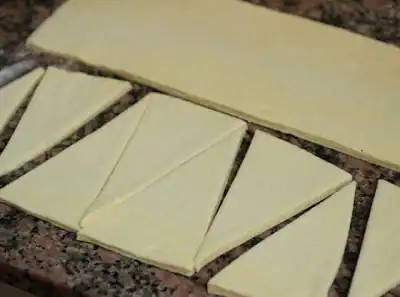
Use a sharp knife and cut cleanly. No sawing. The triangles need clean edges so the layers stay intact. A sawing motion disturbs the lamination right where you want it most, and it can affect the puffiness.
Small croissants bake better, in my opinion. Smaller ones stay crisp all the way through with a higher ratio of golden crust to interior. Larger ones can get soft in the center before the outside is done. That said, it's personal preference, and the recipe works either way.
Glaze after baking, not before. I brush with simple syrup straight out of the oven instead of egg wash before. It gives a beautiful shine and a slight sweetness without the heaviness egg wash can add to delicate laminated dough. If you prefer egg wash, it works fine; it's just not my way.
The final proof matters. After shaping, the croissants need a full 2-3 hours to proof at room temperature. They should look noticeably puffed and a little wobbly when you shake the pan. If they go in under-proofed, the layers won't open properly.

Butter block
The butter block goes in after the first overnight rise.
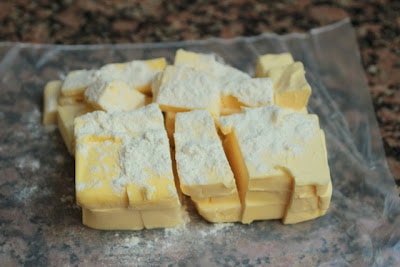
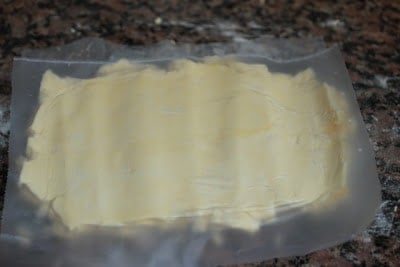
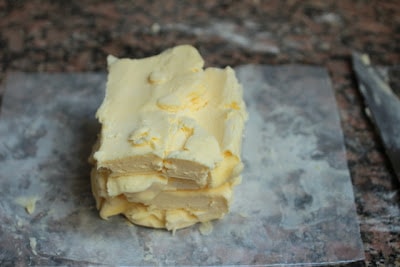
I mix a few tablespoons of flour into the butter before shaping it into a rectangle. Rather than using a mixer, I lay the butter pieces on a sheet of parchment, sprinkle the flour over, top with another sheet, and pound it flat with the rolling pin. Pile it back up and repeat three or four times. Minimal mess, fully incorporated.
Laminating
To laminate is to alternate layers of dough and butter, by folding the dough onto itself, thus creating a final dough that looks like a stack of sheets. They will puff up dramatically in the oven due to that layering effect and the water that
evaporates as steam during baking.
So the layers have to be distinctive; otherwise, the effect will be lost and you will have a mess consisting of flour and butter. If you didn't manage to make puff or croissant pastry rise at some time, you know exactly what I mean. A pool of butter and uncooked dough.
It takes time because the dough has to rest for at least one hour between each envelope-style folding.
The reason for this is the yeast. The gluten activates when you handle the dough, and if it's not allowed to rest it becomes impossible to work with. Just like any yeast dough.
And it's important to mark the dough by making an indentation with your thumb between folds so as not to lose track of them. You don't want to find yourself in the middle of the kitchen, trying to figure out if you are going to make the final turn or if you already made it.
So you mark the dough. Just press your thumb when the fold is done. After the second turn, press your thumb twice. And so on.
Since croissants need three foldings, the last one a four-layer turn, it will take a few hours to complete. And then it has to rest again, otherwise, you won't be able to roll it thin enough to cut the triangles that will become the croissants.
Cutting and forming
Once the dough has completed all its folds and had its final rest, roll it out into a large rectangle, about 20x15 inches.
The dough should feel cold and firm, not springy. If it keeps pulling back when you roll it, cover it and let it rest another 10 minutes in the fridge. Forcing it will only make it snap back, and your triangles will be uneven and the flakiness not develop well.
Fold the rectangle in half and cut into triangles with one clean downward press of a sharp knife.
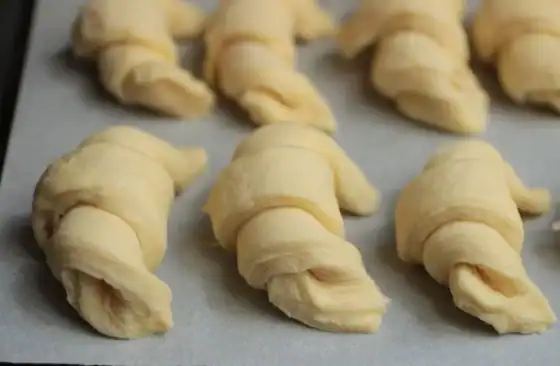
When you get to the shaping, hold each triangle at the wide base and give it a gentle stretch lengthwise before you roll. This helps the layers open up as the croissant bakes. Roll from the wide end toward the point with light, even pressure, and curve the ends inward as you place them on the pan. Press the tips gently onto the parchment so they don't unroll during proofing.
Syrup
I brushed them with simple syrup (sugar covered with water and boiled for two minutes) right out of the oven because I never glaze them before baking. I just don't like it. But the syrup gives them a nice shine and adds a very slight sweetness.

The flavor was amazing, really buttery (what else!) and crunchy, the way a good laminated dough can be.

French Croissants (all-butter)
Ingredients
Yeast mixture:
- 1 ¼ teaspoon active-dry yeast, about ½ package
- 3 tablespoons water, tepid, barely warm
- 1 teaspoon sugar
Croissant dough:
- 1 ¾ cups bread flour
- 2 teaspoons sugar
- 1 ½ teaspoon salt
- ½ cup milk
- 2 tablespoons vegetable oil, I use sunflower or canola oil
- ½ cup 1 stick chilled, unsalted butter
- 1 egg, for egg wash
Instructions
For the yeast mixture:
- Mix the yeast, warm water and teaspoon of sugar in a small bowl.
- Set aside and let foam up a little.
For the croissant dough:
- Heat the milk until tepid and dissolve in the salt and sugar.
- Place the flour in a large bowl. Add the oil, yeast mixture, and milk mixture. Stir all the ingredients together using the rubber spatula or wooden spoon, just until the flour is incorporated.
- Turn the dough out onto a floured surface, and knead the dough several times. Place the dough in a clean bowl, and cover tightly with plastic wrap. Leave for 2 to 3 hours, or until the dough has tripled in size. The time depends on the temperature of the room.
- After the dough has tripled in size, remove it gently from the bowl, pulling it away from the sides with your fingers. Place it on a lightly floured surface, and roll it into a rectangle of about 8x12 inches (20x30cm).
- Fold the dough rectangle in three, like a book or letter, first the top third down until it reaches the middle of the remaining dough, and then the bottom third up.
- Cover the dough in plastic wrap and place on a cookie sheet to rise for another hour or so, or until it has doubled in size. This second rise can be made overnight in the fridge.
For the butter block:
- Place the stick of chilled butter on a piece of parchment paper and, using a rolling pin, lightly pound the butter to flatten it. It will have ridges at first, but pound on the too. It should measure about 10x8 inches (20x25cm).
- Cover with plastic or another piece of parchment paper, and place the butter rectangle in the fridge to chill while the dough is on it's second rise.
Continue with the croissant dough:
- After the dough has doubled, cover in plastic wrap and chill it in the fridge for about 30 minutes.
- Transfer it a lightly floured surface and let it rest for 1 or 2 minutes. Roll the dough again into a rectangle about 15x8 (20x38cm) inches.
- Place the cold butter rectangle in the middle of the rolled dough. Fold the bottom third of the dough up and the top third of the dough down. Turn the dough package 90 degrees (quarter turn), so that the top flap opens to your right, like a book.
- Roll out the dough (gently, so you don't push the butter out of the dough) until it is again about 15x8 inches (20x38cm). Again, fold the top third down and the bottom third up. Cover in plastic wrap, and place it in the fridge for 2 hours.
- Place the cold dough on the lightly floured surface. Tap the dough with the rolling pin, to deflate it a little. Let the dough rest for about 10 minutes.
- Roll it to a 15x8 inch (20x38cm) rectangle. Fold in three again. Turn it 90 degrees (quarter turn) with the top flap to your right, and roll out again to a 15x8 inch (20x38cm) rectangle.
- Fold in three for the last time, wrap well in plastic, and return the dough to the fridge for two more hours.
Cut and shape the croissants:
- Lightly butter your baking sheet.
- Take the dough out of the fridge and let it rest for 10 minutes on the lightly floured surface.
- Roll the dough out into a 20x15-inch (50x38cm) rectangle.
- Fold the dough in half, bringing the top half down. With a pizza wheel or a large kitchen knife cut it into triangles (as shown in the video.). You'll have stacked triangles.
- Open the stack and place the top triangles on top. Half will be fully cut, half will still be joined. Cut the ones that are joined down the middle so you have individual triangles.
- Working with one triangle at a time, hold it from the top with one hand and with the other stretch it out a little to lengthen it. Be careful not to tear it.
- Make small balls of dough from the scraps and place a ball of dough at the wide end of the triangle. This is optional but it gives the croissants volume. I don't usually do it, but I'm more experienced; it's your call.
- Starting at the wide end, roll the triangle up towards the point, and curve into a crescent shape. Place the unbaked croissant on the baking sheet. I like to anchor the ends by pressing gently onto the sheet.
- Repeat the process with the remaining dough. The video shows filled croissants, but that's not what we're making today.
- Leave the tray of croissants to rise for 3 hours.
Bake the croissants:
- Preheat the oven to very hot 475°F (245°C).
- For the egg wash: mix the egg with a teaspoon of water. Brush across the tops of the croissants.
- Bake for about 20 minutes, until the tops are golden brown, rotating the baking sheet after 10-12 minutes so they bake more evenly. If they're browning too quickly, decrease the oven temperature to 375°F (190°C). They should have golden bottoms and not be doughy.
- Place the baking sheet on a rack to cool for 10 minutes before serving.

kathyskitchentable says
Wow! These are beautiful! Making croissants is on my list of things I want to make at home this year.
Christine @ 24 Carrot Kitchen says
These look so good! I must confess, I have always been intimidated by making croissants. My tween loves them and I usually buy a package for her at Trader Joe's. I bet they are so much better fresher and homemade.
I will give them a try! Thanks for the post.
saucygander says
Love love the flaky layers, they look sooo good, especially with the glaze. And you make it all sound so ... cool and calm! Your experience really shows here, and I wish I was there for one of the little "perfect bite" croissants!
Lora CakeDuchess says
I bet your stepkids loved your baking and gosh, what will I do tonight because I want a slice of your bundt and a couple of these gorgeous croissants!
Karen (Back Road Journal) says
Oh my goodness...look at your lovely croissants. Love all the beautiful buttery layers.
yummychunklet says
Your croissants look amazing. Yum! Can't wait to try these.
Holly @ abakershouse.com says
Wow- I am so impressed! These are beautiful and on my list of things to try to make. The pile of butter is enough to make me swoon and to see your perfect dough is just wonderful. Simply fantastic!
Susan says
OMG, Paula - these are amazing! I've never attempted Croissants before. I can only imagine how great they taste!
Cathleen says
Beautiful. Interesting glaze - it does give them a nice shine.
gfcelebration says
Your croissants look just about perfect, Paula. Great job. Beautiful photos as always.
Laura Dembowski says
What beautiful croissants, Paula! I have never tackled such a recipe but hope to one day. Though they may not have come out exactly as you wanted, they look great to me.
Lisa says
Great job documenting the process. How different is Nancy S's recipe?
e / dig in says
paula, you make your own croissants? i am truly in awe of you. thanks for explaining the process so clearly - you make it seem doable.
i can taste the buttery flakiness from here 🙂
Nancy @ gottagetbaked says
Wow is the only word necessary for this post, Paula. Making croissants is truly a looooong labour of love, lol. Sounds like I'd have to mark off an entire weekend to make these. I love all your helpful hints (especially the one about incorporating the flour into the butter) and in the end, you have absolutely perfect looking, delicious, flaky, layered croissants. You say they turned out flat but in my eyes, they're perfect!
Carol | a cup of mascarpone says
Paula, these are amazing! I love how you took the time to explain the process so well. I have never made croissants, but have made a croissant type filled Italian pastry...so I imagine it's somewhat similar. I would love to try. I so wish I could have one with my afternoon coffee right now, as I watch the snow fall here in Northern Virginia!
Gloria says
Love these croisssntas Paula look delicious:)
I bookmarked!
Me encantaria hacerlos luego.Paula me encantan!
Cher Rockwell says
Paula - these are beautiful.
I found the dough didn't roll out quite as easily as I wanted, but I did discover that thwacking the dough with my rolling pin did help me push it out to the desired length. (And I am learning to really appreciate the investment I made in the Matfer nylon rolling pin - I no longer see it as a luxury, but a vital kitchen tool)
pamkaren says
I like how you prepped the butter! Your croissants look lovely...
Kathy says
Since I was away for the last month, and on the road for the past few days, I never got these done. However, this is one recipe that I have been waiting to try…so today I will begin my dough. Hopefully they come out as lovely as yours! They look magnificent, Paula!!
Andrea_TheKitchenLioness says
Well, Paula, you know, of course, that you have beaked the most perfect looking Croissants ever! I cannot believe how they look like pure buttery perfect bliss! When I attempted mine, I was actually thinking of you and knew that you would ace this recipe and you did! Respect! I just wanted to let you know that the only reason that I added chocoalte to mine or made these funny looking pains au chocolat is because Esther MacManus added chocolate to hers in the video not because I was plunging ahead in the book.
Have a lovely Wednesday!