



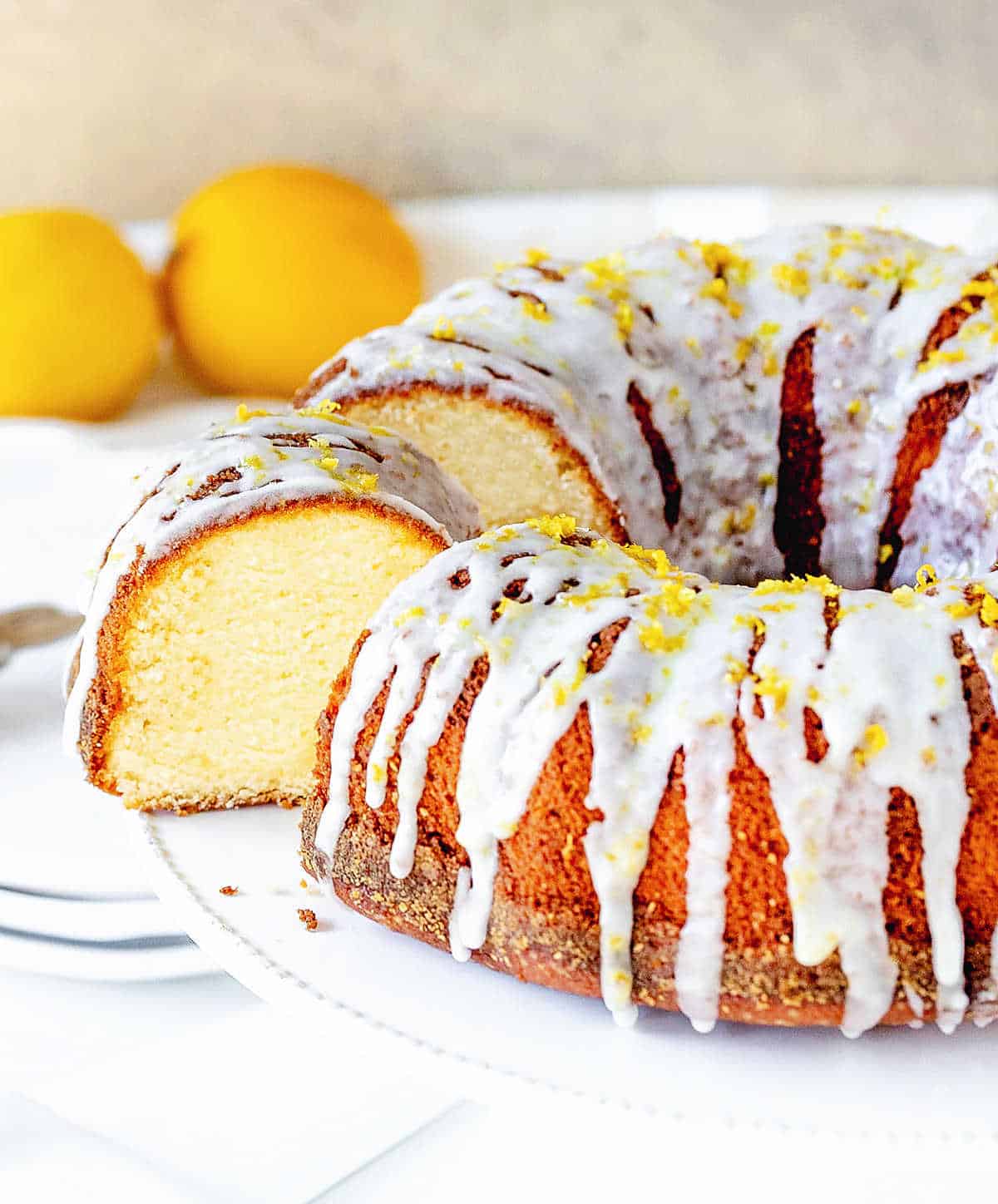
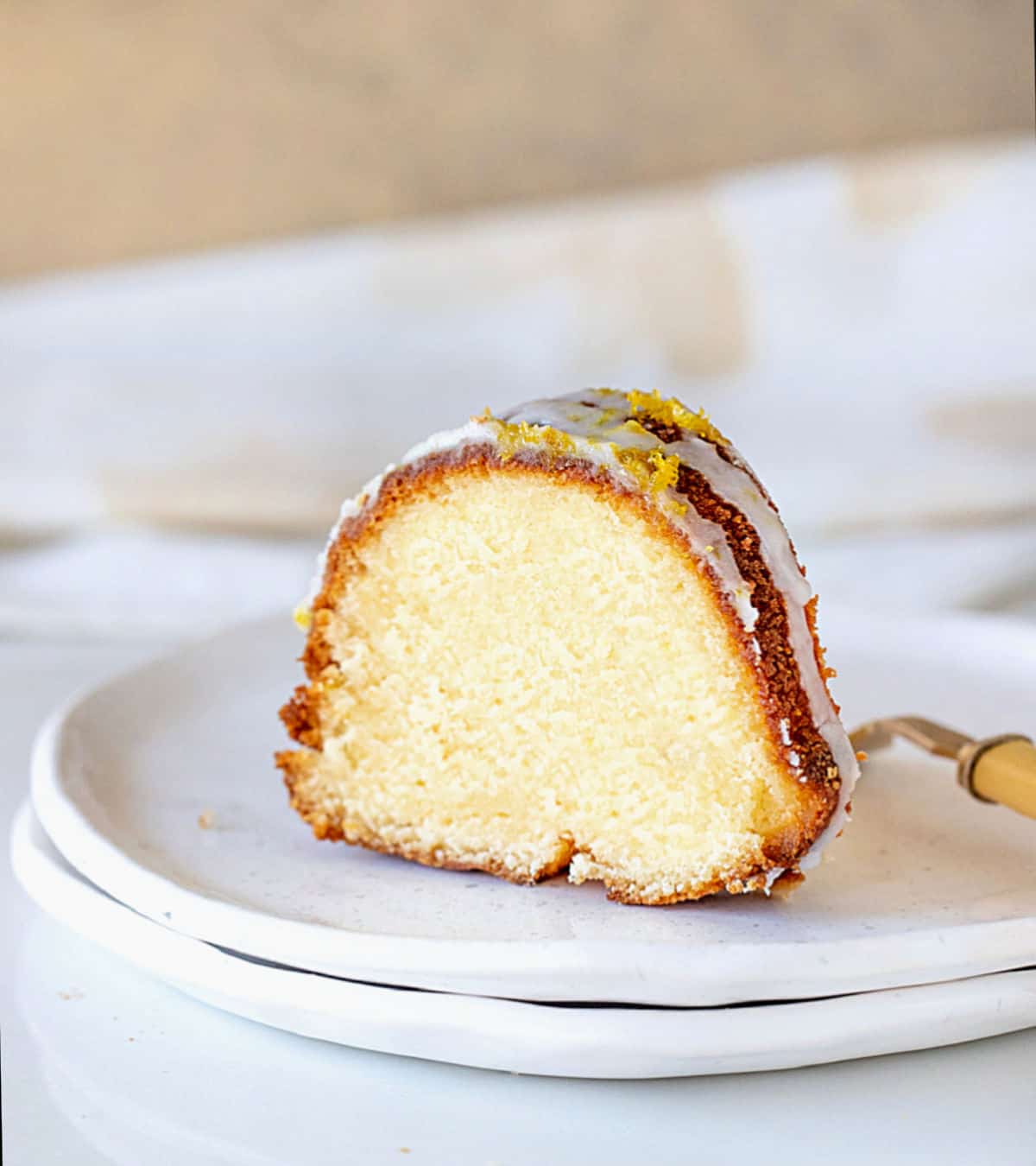
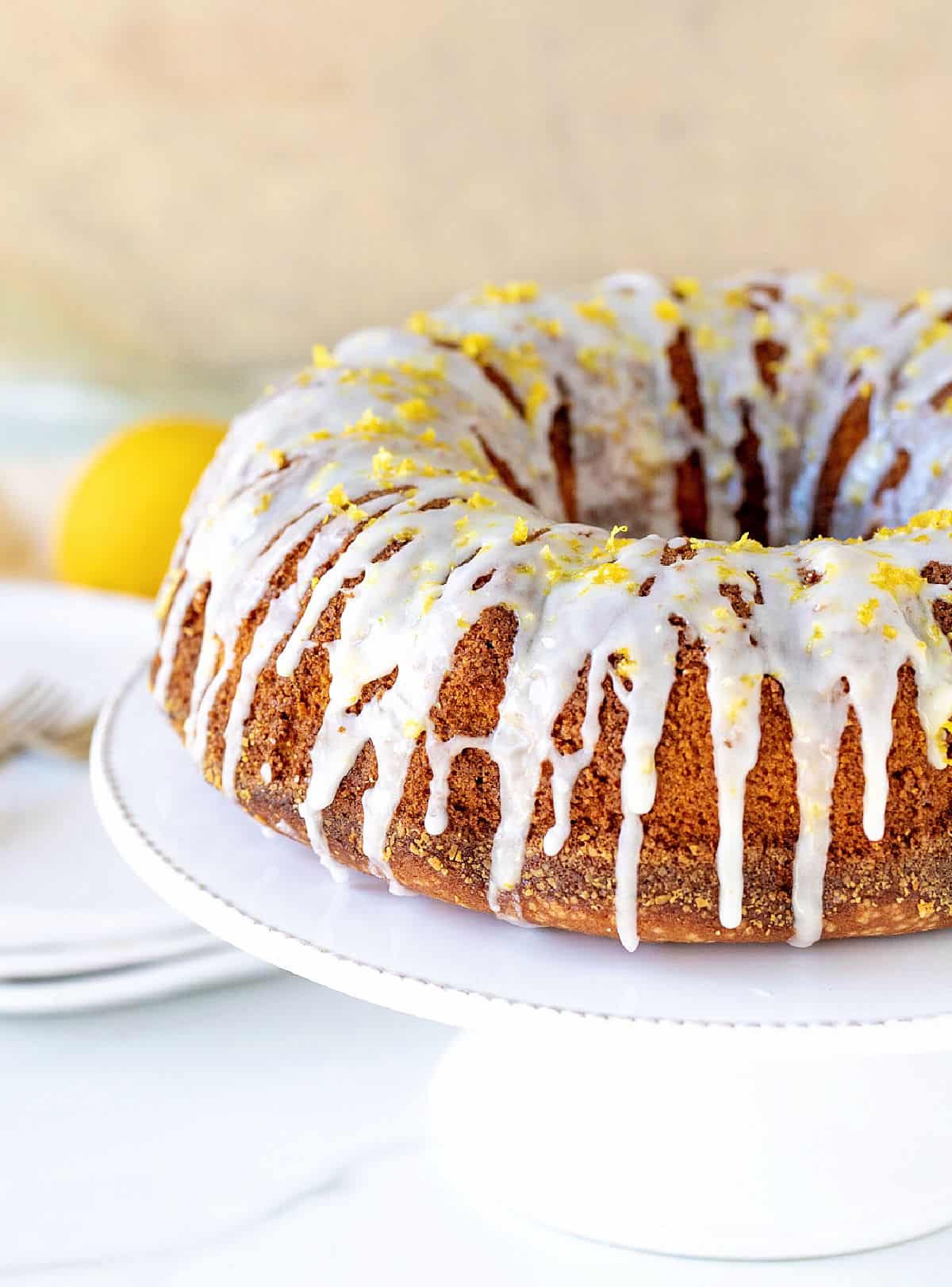
If you're a lemon lover looking for a simple cake with lots of flavor, this is it, thanks to the lemon zest in the batter and sweet citrus glaze. It keeps well and has a wonderful melt-in-your-mouth crumb, similar to a moist pound cake. You can use a bundt cake or two loaf pans, letting you freeze one for later.
An accidental recipe
At some point during my recipe testing, I forgot to add the last part of the flour, almost a third of the amount. The cake was already in the oven, so what's a girl to do but hope it's not a complete flop, right?
Well, it was a definite win! It was way better than I expected, and it had just the right amount of dry ingredients to ensure a soft, moist crumb without compromising the cake's structure.
In this little blog, we love both bundt cakes and lemon-flavored everything. So you can well imagine it was a no-brainer to post this old-fashioned lemon bundt cake recipe.
- Zesty and bright lemon flavor: it has lemon zest and fresh lemon juice in the batter, and a lemon glaze. So all you lemon lovers can swoon with every bite you take.
- Make ahead: it keeps well for a few days and freezes wonderfully for a month or more.
- Lemon dessert: it acts as a lemon pound cake, so it's an excellent base for a trifle, to serve slices with a dollop of whipped cream or lemon curd and fresh berries or to make as a sheet cake, add a layer of lemon frosting and serve at a gathering, as I do with this coconut and lemon cake.
Testing notes
Lemon flavor: you can add more or less of the lemon zest quantity specified in the recipe to adjust it to your palate. The mix of juice and zest is a lemon flavor powerhouse, and this recipe will give you an intense experience. If you like a mellower flavor, add more vanilla extract, up to a teaspoon, and lower the zest to half a tablespoon.
Removing it from the pan: This is a tricky answer, as all pans are different. I leave it to cool down on a cooling rack for about 20 minutes and then shake the pan lightly to see if the cake loosens up on its own. If it doesn't, I carefully insert a smooth-bladed knife down the sides to see if there's something stuck there. Then, I shake it gently again. I then let it cool some more, maybe 15 minutes, and remove it carefully, putting the wire rack over the pan and inverting it.
It's best eaten at room temperature. And if you don't want to use a simple glaze, a dusting of powdered sugar on topworks just fine. Or use nothing at all, as this is a fantastic plain cake.
Keeping this cake moist and tender after baking is important. Don't overbake it, and keep it covered with plastic wrap or in an airtight container for two days at room temperature, or freeze it for longer storage. For lemon cakes, an extra step that adds more moisture is to brush a lemon syrup when you take them out of the oven, similar to what we do to the lemon poppy seed muffins. So that's also an option.
Ingredients
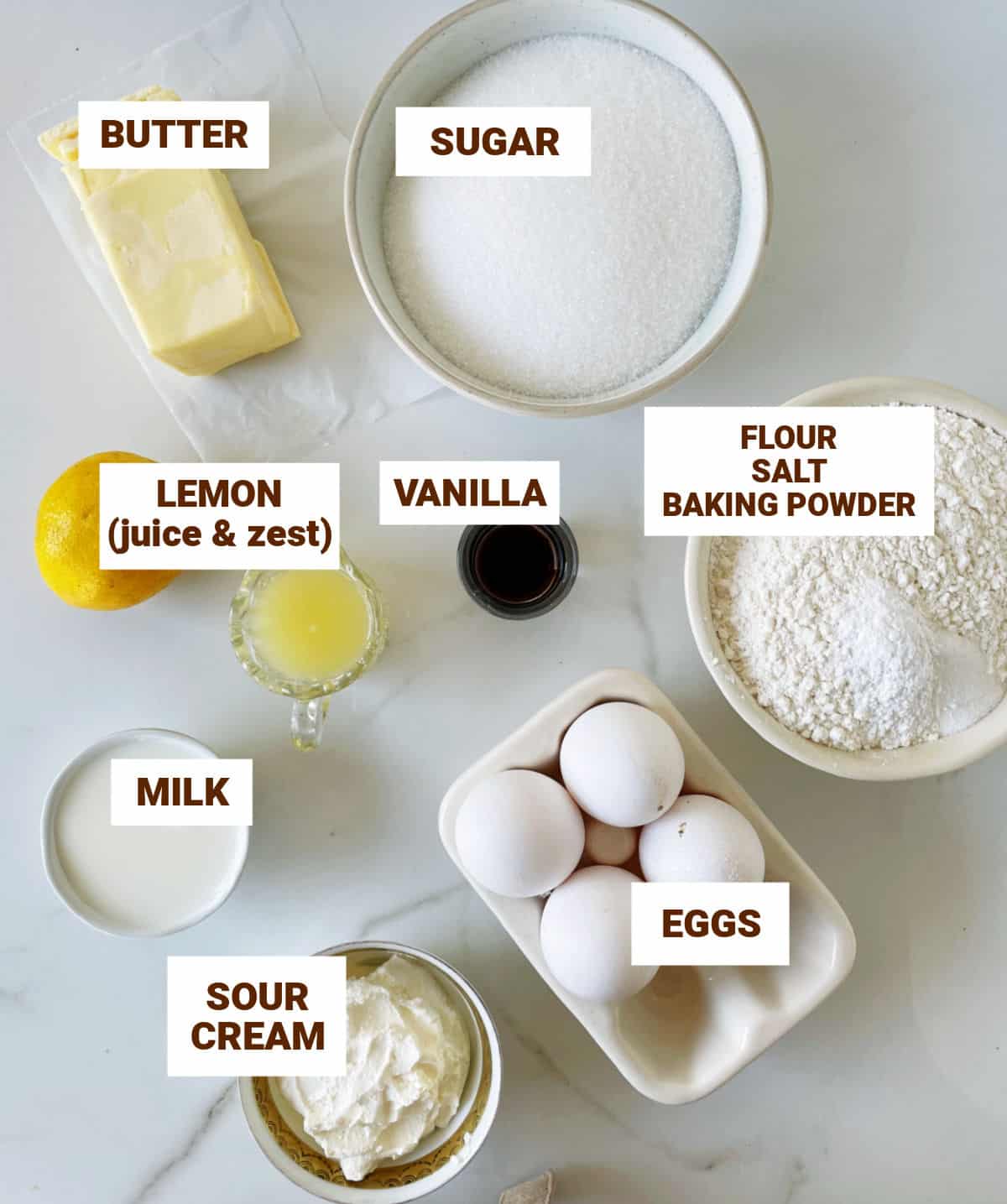
Quantities are listed on the recipe card towards the end of this post. The Ingredients page has more details and lists the brands we use.
- Lemon: Use fresh lemon juice and lemon zest.
- Sour cream: Use the regular type, full-fat sour cream. It adds richness and moisture.
- All-purpose flour or cake flour, both work.
- Baking powder: make sure it hasn't expired.
- Milk: Whole milk makes for a richer cake, but you can use 2%.
Preparing the bundt pan
If you bake bundt cakes often, you've likely had one stick to the pan. It's frustrating, but preventable. Here are three reliable methods:
- Shortening and flour: Coat the pan thoroughly with soft shortening using your fingers or a brush, making sure to reach every corner, including the center tube. Dust with flour, rotating the pan to cover evenly, then tap out the excess over the sink.
- Cake goop (pan-release paste): Mix equal parts shortening, flour, and oil into a paste. Brush it onto the pan. Store leftovers in a jar-1 month at room temp or up to 3 months in the fridge. This is one of my favorite methods.
- Baking spray with flour: Only use baking spray that includes flour. Regular cooking spray isn't enough and often leads to sticking. I rarely use this anymore.
The recipe matters too: When I find a bundt cake that releases cleanly, even without perfect prep, I hold onto it-it's a keeper.
Steps to make glazed lemon cake
This is, in essence, a butter cake.
You can use a large bowl and an electric mixer, or a stand mixer with the paddle attachment. It's the best choice to cream the ingredients well.
Scraping the sides is important throughout the beating and mixing process to ensure that the ingredients are well integrated.
Alternating wet ingredients and flour mixture: have ingredients at the temperatures specified in the recipe and add them in parts, starting and ending with dry ingredients (also called flour mixture). This will ensure that they all integrate correctly. If using a stand mixer, use it on low speed when you start incorporating the flour. Beating it too much makes for a tougher cake.
Sifting
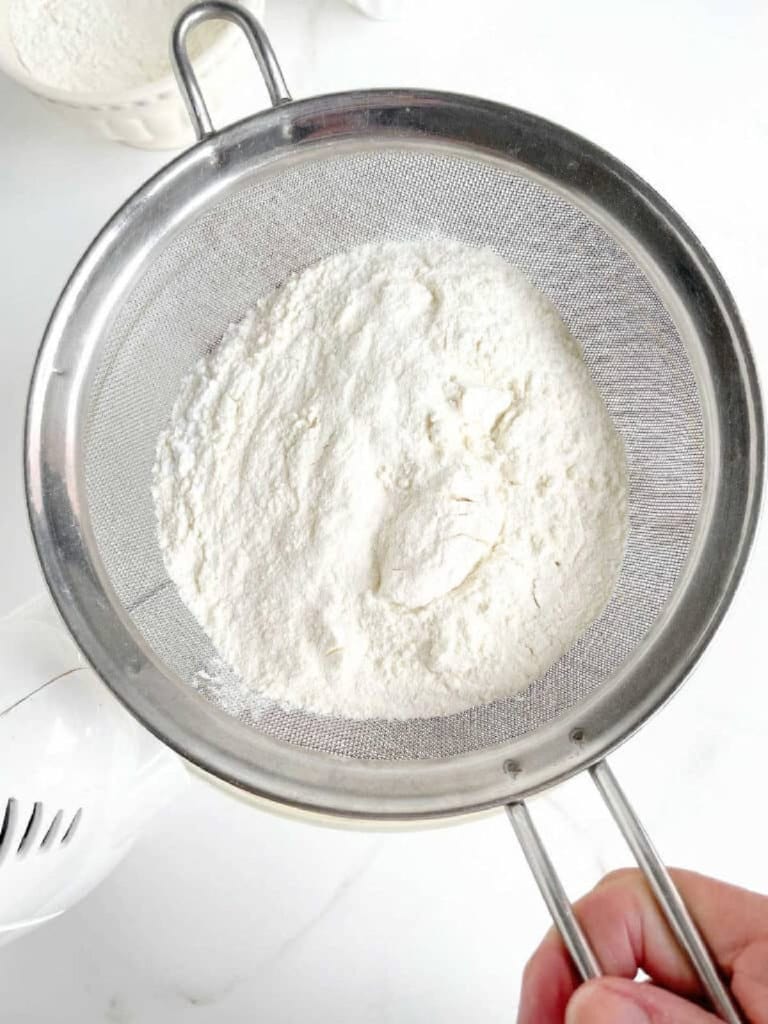
It's important to sift the flour mixture to avoid clumps or impurities. And it helps with fluffiness.
You can sift them before or have the ingredients measured and sift them directly over the butter mixture (my choice).
Last mix
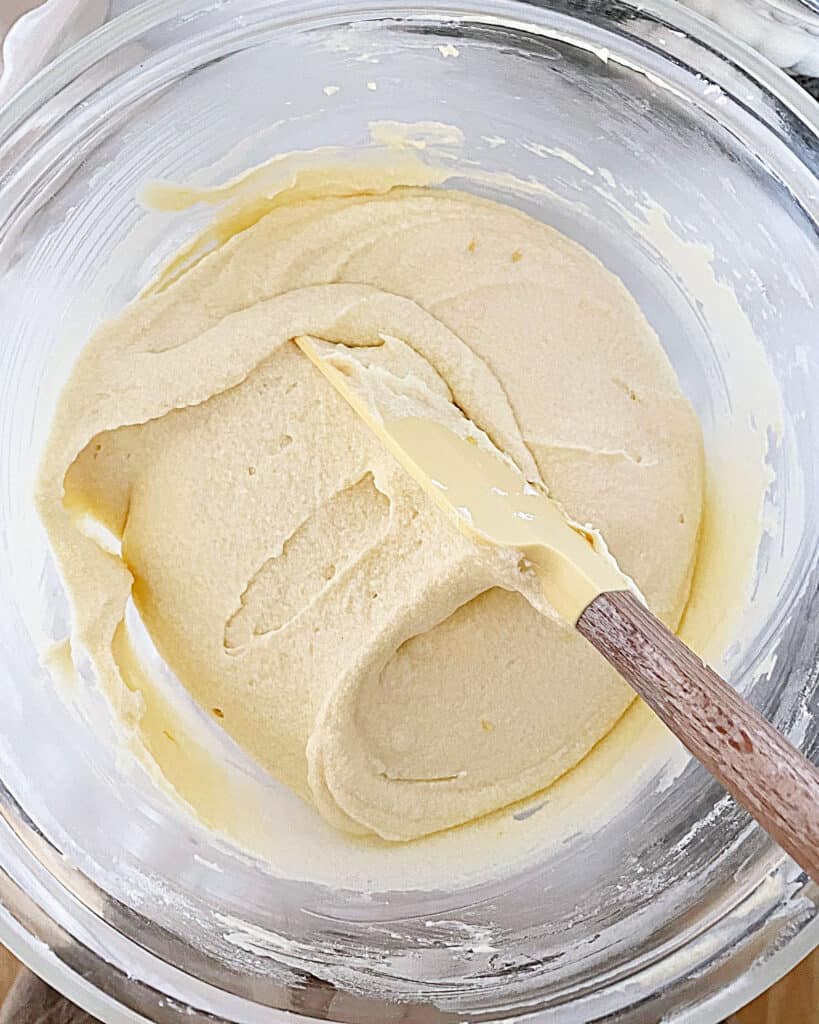
I highly recommend you mix the batter with a spatula at the end, before pouring it into the prepared cake pan. Scrape the bottom to check there are no forgotten flour spots.
Vintage Kitchen Tip
After incorporating flour into a cake batter, we don't want to develop gluten, as it will toughen the baked cake. So mix *just* until it's all well incorporated, but don't overbeat. I like to end mixing with a silicon spatula to ensure the ingredients are fully integrated.
Filling the pan
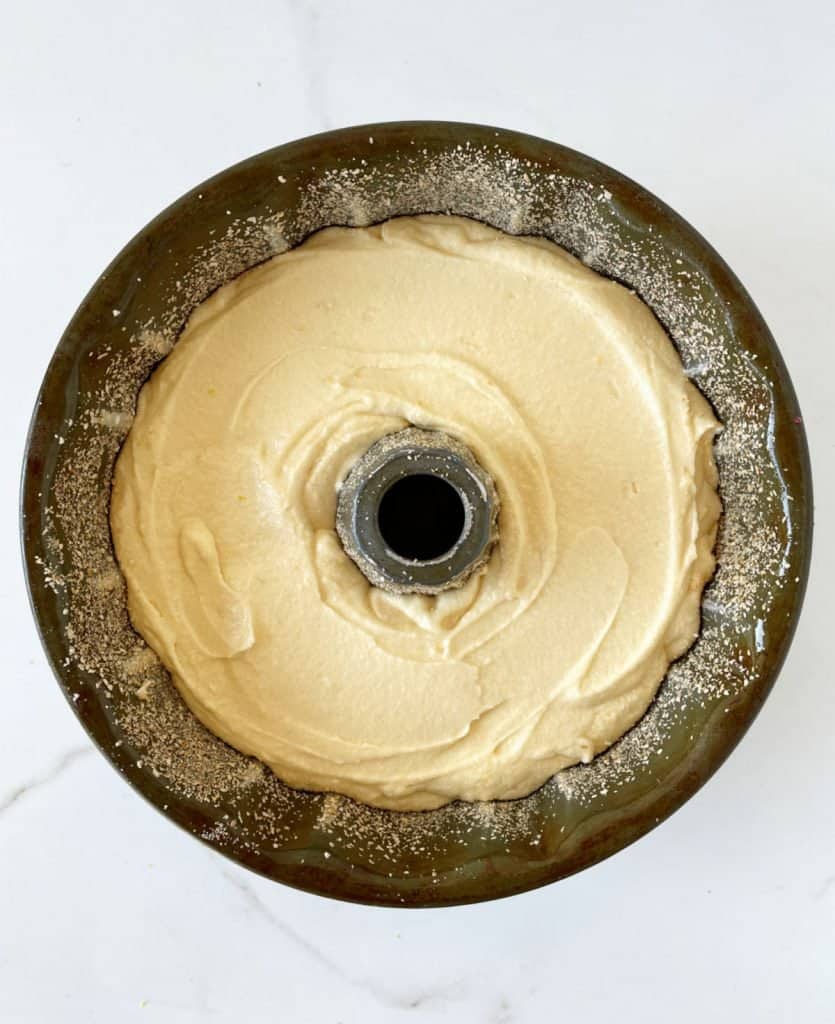
The bundt cake pan should be filled ⅔ to ¾ of its capacity, no more than that. This way, the batter has space to grow and bake well without overflowing or taking too long.
Baking
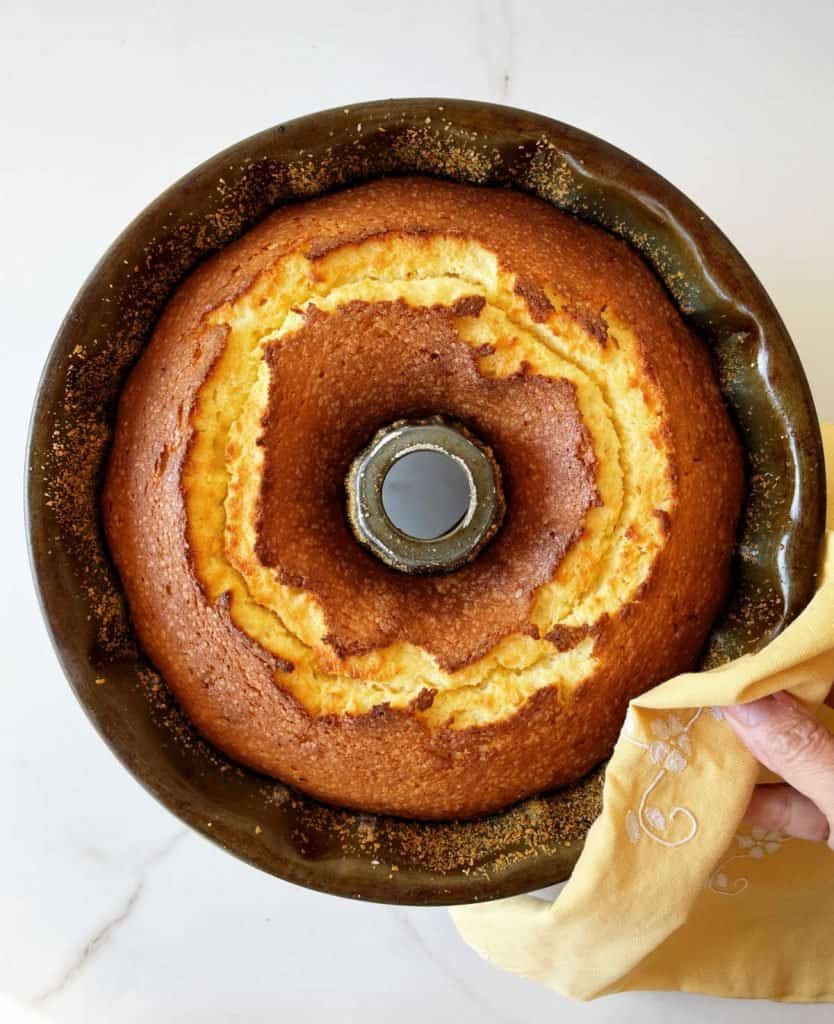
How long should you bake it? The baking time is in the recipe card, of course. But always remember that ovens and pans vary. Start checking when you're about ¾ of the time specified to see how your own oven behaves. Cakes can take a few minutes more or less. The top will usually crack, and that's fine. When a cake tester or toothpick inserted in the center comes out clean, take it out and place it on a wire rack.
Lemon glaze
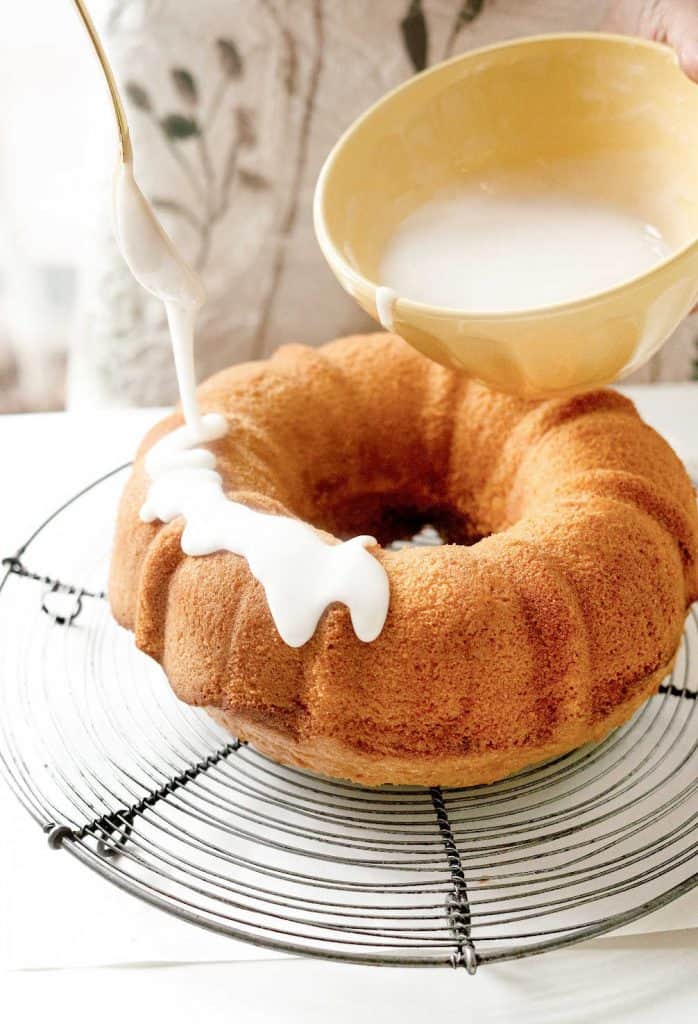
I use a simple powdered sugar glaze, which I believe is the easiest and the one that complements this cake the most.
- Light cream cheese glaze: similar to the one in the banana bread cake recipe, you can use it as an alternative to the powdered sugar one. But add some lemon zest for an extra punch of lemon. Otherwise, the cream cheese frosting will be too sweet.
How much liquid should you use?
This is the million-dollar question, and it depends on how thick or thin you want the glaze to be. Start with half of what any recipe says, mix well and add more as needed, a teaspoon at a time, until you reach the desired consistency. It should resemble thick honey.
Add more liquid per cup of sugar for a thinner icing, like in this apple walnut loaf. Add less liquid, and you have a thicker icing that will not drip down much, like in this old-fashioned zucchini cake. The choice is completely up to you.
If you made this recipe and loved it, you can comment below and leave a 5-star ⭐️ review. Also, if you had issues, let me know so we can troubleshoot together.
You can also subscribe to our FREE email series 'Baking the Best' and our regular newsletter. Or follow and save my recipes on Pinterest.
As an Amazon Associate, I earn from qualifying purchases. Read my disclosure policy.

Lemon Bundt Cake with Glaze
Ingredients
For the cake:
- 2 tablespoons shortening, soft, to grease the pan
- 2 tablespoons flour, to coat the pan
- 1 cup unsalted butter, at room temperature
- 2 cups sugar
- 4 eggs, at room temperature
- ½ teaspoon vanilla extract
- 1 tablespoon lemon zest, from about 1 large lemon
- 2 ¼ cups all-purpose flour, or cake flour
- 1 teaspoon baking powder
- ¼ teaspoon salt
- ½ cup sour cream, at room temperature
- ¼ cup milk, or buttermilk, at room temperature
- ¼ cup fresh lemon juice
For the glaze:
- 1 cup powdered sugar
- 2 to 3 tablespoons lemon juice
- extra lemon zest, for decorating
Instructions
For the cake
- Preheat oven to 350ºF (180ºC).
- Grease a 10 or 12-cup bundt cake pan (26cm) with 2 tablespoons shortening, covering every angle, nook and cranny. Dust with 2 tablespoons flour, shaking off excess. Reserve.
- Beat 1 cup unsalted butter in a large bowl at medium or high speed, while adding 2 cups sugar gradually until the mixture is creamy, about 3 minutes. You can use a hand-held electric mixer or a stand mixer.
- Add 4 eggs, one at a time, beating well each time to combine.
- Add ½ teaspoon vanilla extract and 1 tablespoon lemon zest and mix.
- Sift 2 ¼ cups all-purpose flour, 1 teaspoon baking powder and ¼ teaspoon salt (I have them measured and sift them directly into the batter) and add them in 3 parts to the egg mixture, alternating with ½ cup sour cream, ¼ cup milk and ¼ cup fresh lemon juice in 2 parts. So you add: ⅓ of the dry ingredients, then the sour cream and half the milk and mix, then ⅓ more of the flour, the rest of the milk and lemon juice, and the final ⅓ of the dry ingredients.
- Mix lightly at low speed every time you add a dry or wet part; there's no need to beat thoroughly after each addition, except the last one. Mix well but don't over beat. I highly recommend you run a rubber spatula at the end and make sure there are no dry spots before pouring the batter into the pan.
- Pour mixture into the prepared bundt pan.
- Bake for about 45 minutes, or until a tester comes out clean. This time is estimated according to my oven and pan, but it can take a little less or more for you. So start checking towards the 35-40 minute mark. Cover loosely with a piece of aluminum foil if the top of the cake browns too quickly and continue baking until completely done.
- Let cool 20 minutes on a wire rack and carefully shake the pan to see if the cake loosens by itself. You can use a smooth-bladed knife and insert it between the cake and the edges of the pan and gently loosen the parts that might've stuck during baking. Again shake the pan carefully. You should feel that the edges and the bottom of the cake is loose.
- Remove the cake by putting the wire rack or a plate on top of it and flipping it with both hands with a kitchen towel that allows you to grasp both the wire rack (or plate) and the edges of the cake pan at the same time. Remove the bundt pan and flip the cake with the wire rack so it's on top of it again but without the pan.
- Let the cake cool completely on the wire rack before glazing.
For the glaze:
- Mix 1 cup powdered sugar and 2 to 3 tablespoons lemon juice in a small bowl until smooth and shiny. Start with the 2 tablespoons of juice and add more by the teaspoon if necessary. It should be like honey for a light glaze. If you want a thicker glaze, add less juice until you have a mixture like very thick honey.
- Drizzle on top of the cooled cake and let drip down the sides.
- Sprinkle with extra lemon zest if you want to. Let dry.
- Eat at room temperature.
- Wrap leftovers and keep them at room temperature for a day or two, or refrigerate them for 4-5 days.
Notes
Grease and flour: I use soft shortening to patiently cover the whole pan, every nook and cranny, every sharp angle, every single bit of space available. I use a brush or my fingers. I then flour the pan, shake off excess. So far, it has never failed.
Baking spray: If you use it, make sure that it's labeled as having flour in it, or being specifically made for baking. It has to have flour in it. Otherwise, you have a high chance of the cake sticking when removing it. That is my experience, at least. Lemon flavor: you can add more or less of the lemon zest quantity specified in the recipe to adjust it to your palate. The mix of juice and zest is a lemon flavor powerhouse, and this recipe will give you an intense experience. If you like a mellower flavor, add more vanilla extract, up to a teaspoon, and lower the zest to half a tablespoon. Serving it: this delicious cake is best eaten at room temperature, in my experience. And if you don't want to use a simple glaze as we did here, a dusting of powdered sugar on top of the cake works just fine. Or use nothing at all really, this is a fantastic plain cake that can be used to make a quick dessert by serving a slice with a dollop of whipped cream and some berries or lemon curd on the side.

Debbie Clifford says
Can you use Splenda not sugar
Paula Montenegro says
I never use Splenda Debbie, and I don't know if it would work for this recipe.
angiesrecipes says
What a fine cake! The cake looks fabulous and perfect even without the fancy glaze and lemon zest.