


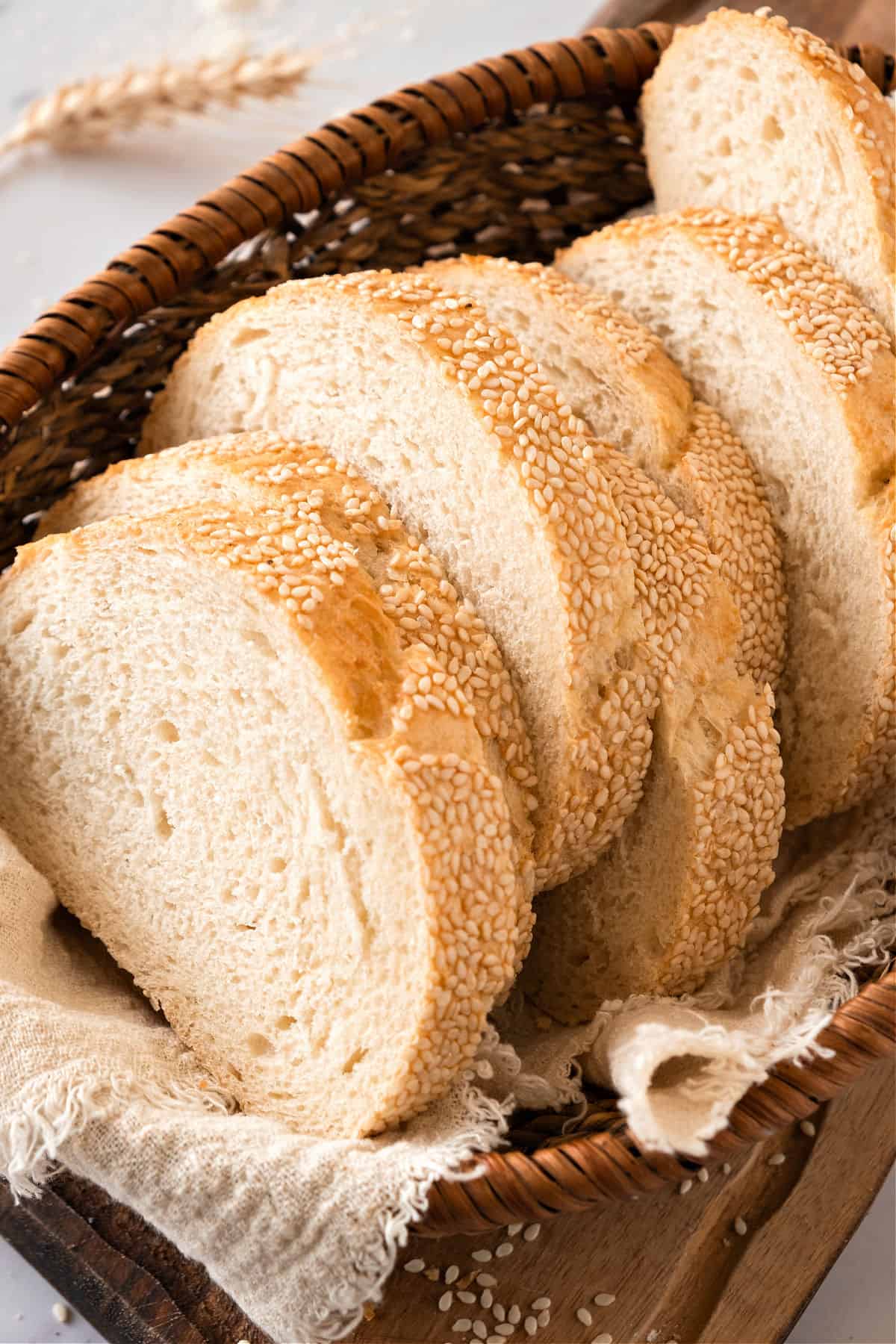
Making homemade semolina bread feels rustic and a little old-world. It has a golden hue, chewy crumb, and a crust that toasts beautifully. This recipe uses a mix of semolina and bread flour to strike a good balance between structure and flavor.
This unique Italian bread is one of our most popular ones on this blog, and I'm updating it with new images, testing notes and tips. If you're not an experienced yeast baker, there are step-by-step instructions to guide you.
SAVE THIS RECIPE
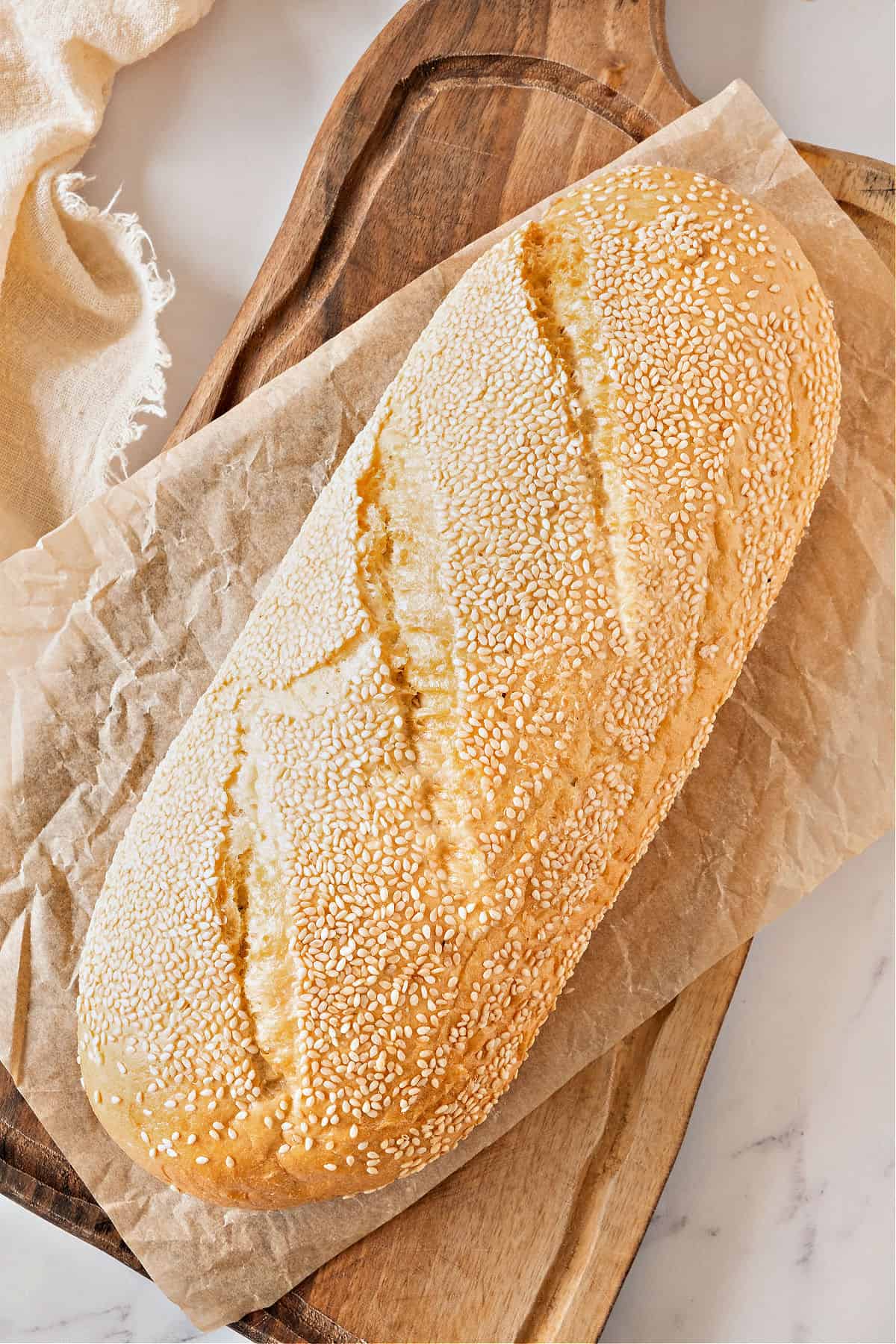
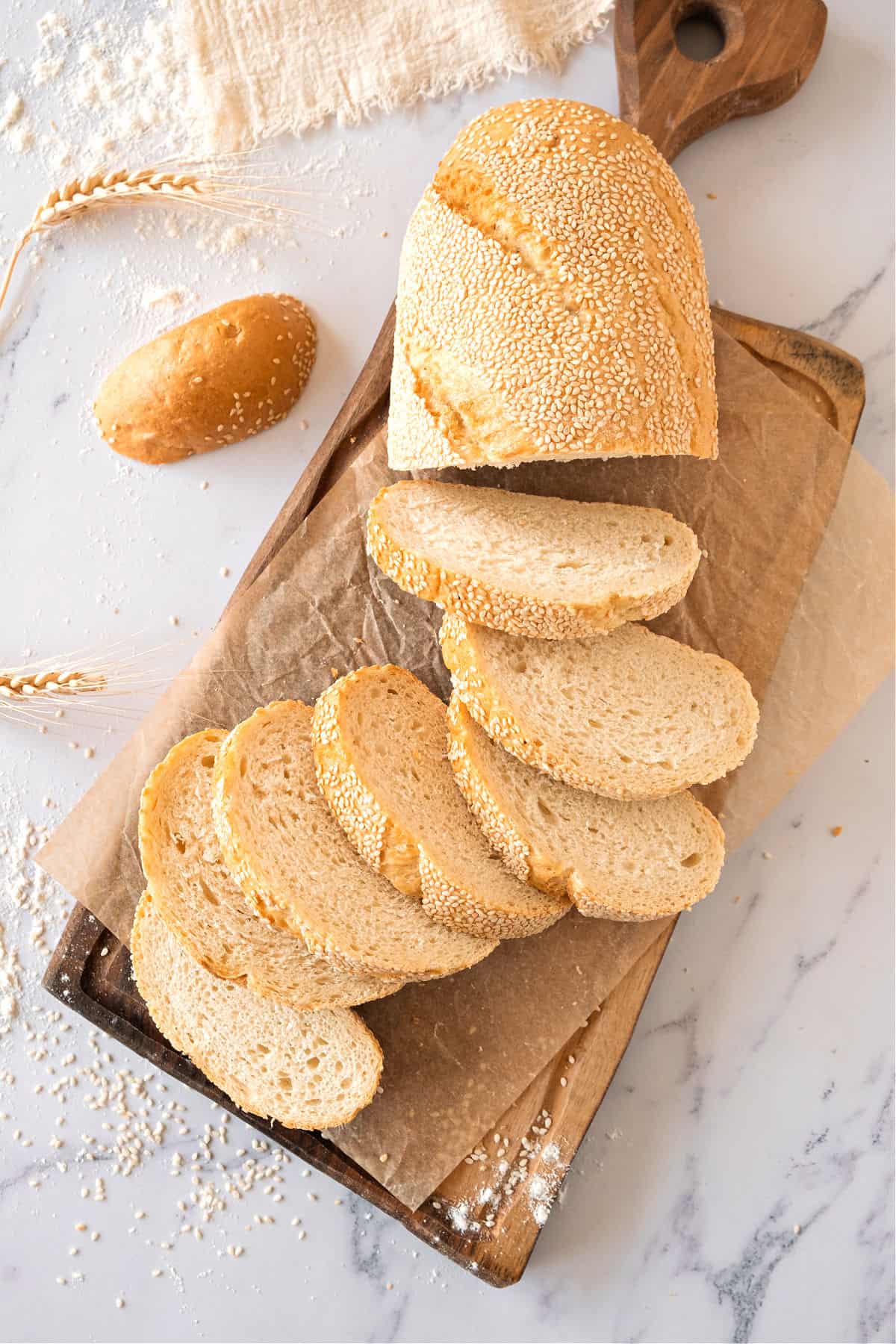
A golden loaf
I must admit this golden, crusty bread is one of my favorite ones to bake and eat! And though baking with yeast is not everybody's thing, some bread recipes are worth the time, dedication and patience. This is one of them, for sure.
It's everything you want in a crusty bread. I coated it with sesame seeds, but you can leave it plain, as I used to do. Both ways, this semolina loaf is fantastic!
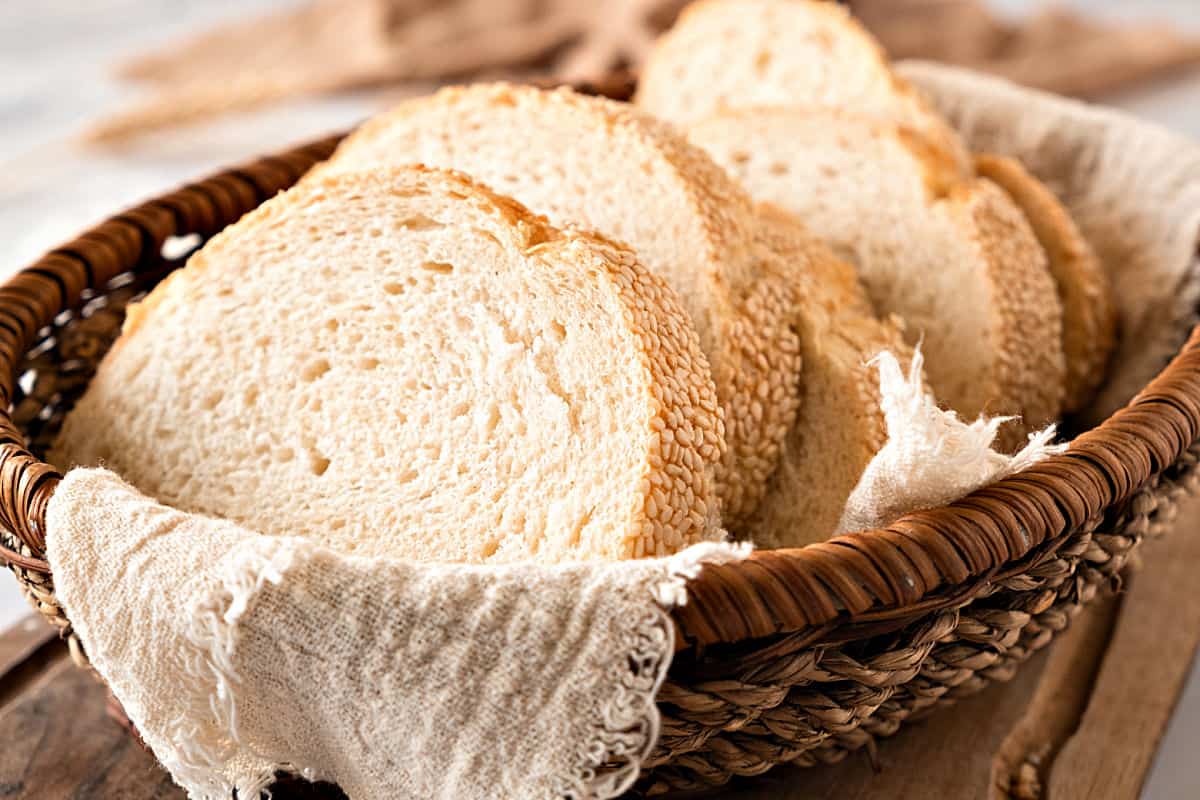
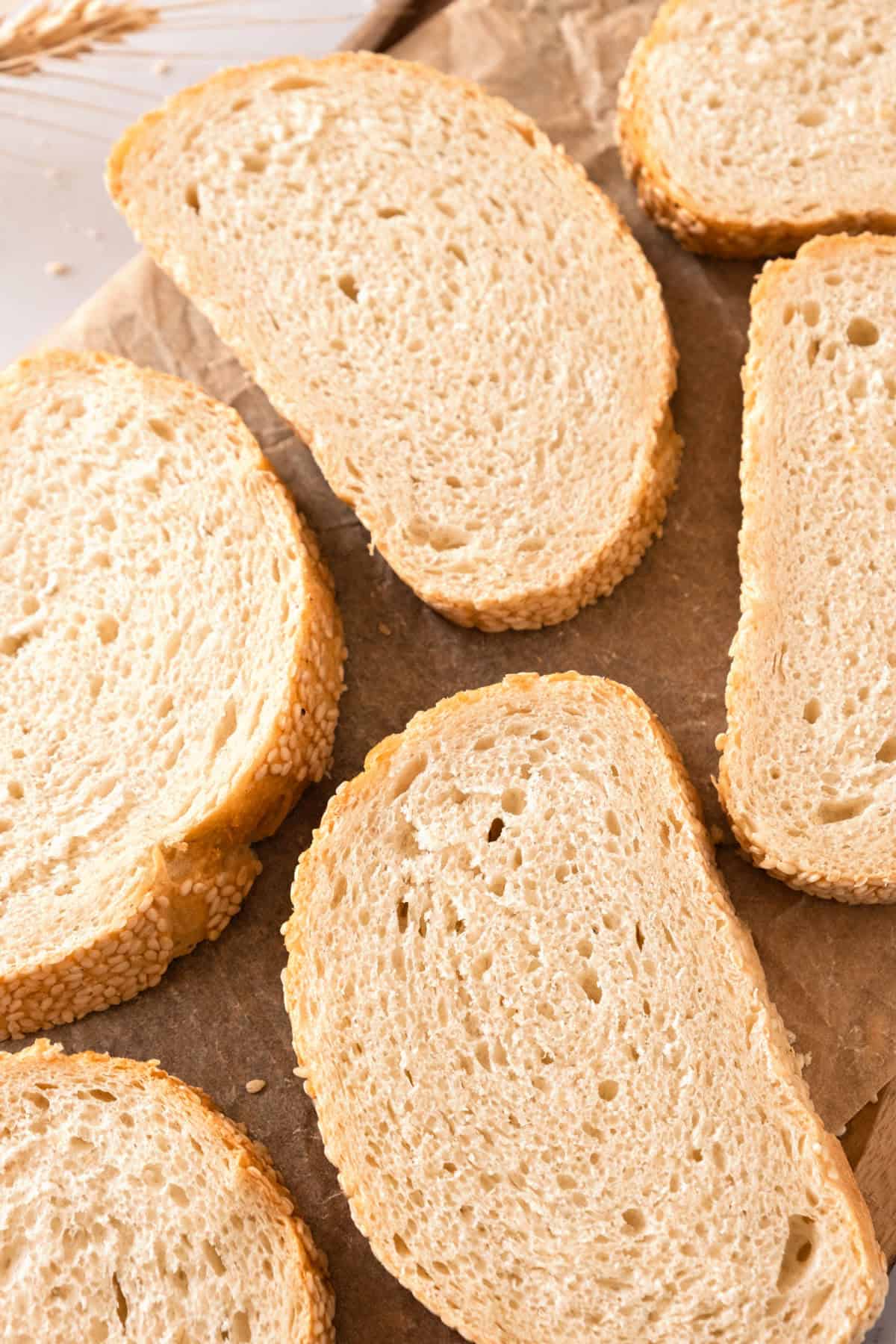
The texture is different from soft sandwich bread and more similar to an artisan bread: firmer, heartier, but still great for slicing, layering with butter, or dipping into soups and olive oil.
What is this rustic Italian bread good for? It's great for buttered breakfast toast, bruschetta and some sandwiches. Use it as an appetizer to dip in olive oil or as part of an antipasto platter. It makes the best croutons, and to pair with a stew or tomato sauce pasta.
Other bread recipes to make after this one are the yeasted beer rolls and semolina rolls, both great for sliders and to accompany saucy dishes.
Testing Notes
- Organization: bread baking takes time. So read the recipe first and plan for it. Ensure you have ingredients at the correct temperature, utensils and equipment needed, and enough workspace. This will make the process so much easier.
- Use fine semolina flour (not coarse): You want semola rimacinata or fine durum wheat flour. Coarse semolina (like the kind used for pasta or porridge) won't hydrate properly in bread dough.
- Combine it with bread flour: Semolina alone doesn't form strong gluten networks, so mixing it with bread flour gives better rise and structure.
- When proofing the dough (letting it rise), make sure the bowl is large enough to hold double or triple the volume comfortably without overflowing.
- Temperature of the room: let it rise in a draft-free, warm place. If the room is cold, take it to a warmer place or wrap it around something that keeps the temperature, like a sweater, blanket, or shawl, like I do.
- Sesame seeds, yes or no? You can go either way. I used to bake it plain, but added seeds when I reshoot it. Covering the loaf with sesame is a classic way of presenting this bread.
- To cover semolina bread with sesame seeds, lightly moisten the surface with water (I don't like an egg wash for this recipe), just enough to help the seeds stick. Use a brush or a spray bottle with water for an even coating. Spread sesame seeds in a flat layer on a tray. Gently roll or press the dough into the seeds until evenly coated. You can also sprinkle extra seeds on top and press lightly so they don't fall off. Then transfer the loaf to the baking sheet or pan with parchment paper and bake as directed. Do this before scoring the loaf.
- The loaves can have slight differences every time you bake them. If proofed correctly, the flavor will always be fantastic. But sometimes the crust might be thinner or slightly thicker, the golden hue of the crumb might vary, and so on. Bread uses yeast, and it's a living organism. So, it can be temperamental depending on the humidity, warmth of the environment, etc.
- If freezing it, slice it first: this is an excellent bread to freeze and have ready to toast. Slice it and wrap it in plastic or put it in a Ziploc bag. It will last for a month.
FAQ
Semolina absorbs more water than regular flour. Let the dough rest for 10-15 minutes after mixing to give it time to hydrate before deciding to add more liquid.
Definitely. Just be prepared to knead for 10-12 minutes to develop the gluten properly. A stand mixer makes it easier, but it's not essential.
Yes. You can shape it however you like. Adjust baking time depending on the size and shape of the dough.
Bake in a hot oven and use steam, either by quickly spraying water in a spray bottle, or throwing a few ice cubes at the bottom of the oven when the loaf goes in. Do this quickly so the steam is caught inside.
Flours you need
- Bread flour: You can buy flour that is specially made for bread. It has more gluten than all-purpose. Gluten is the ingredient that develops during kneading, creating a structure that helps the bread grow. The bread will work with all-purpose flour (but not cake flour), but it's a good idea to use the right one, and you can buy bread flour online.
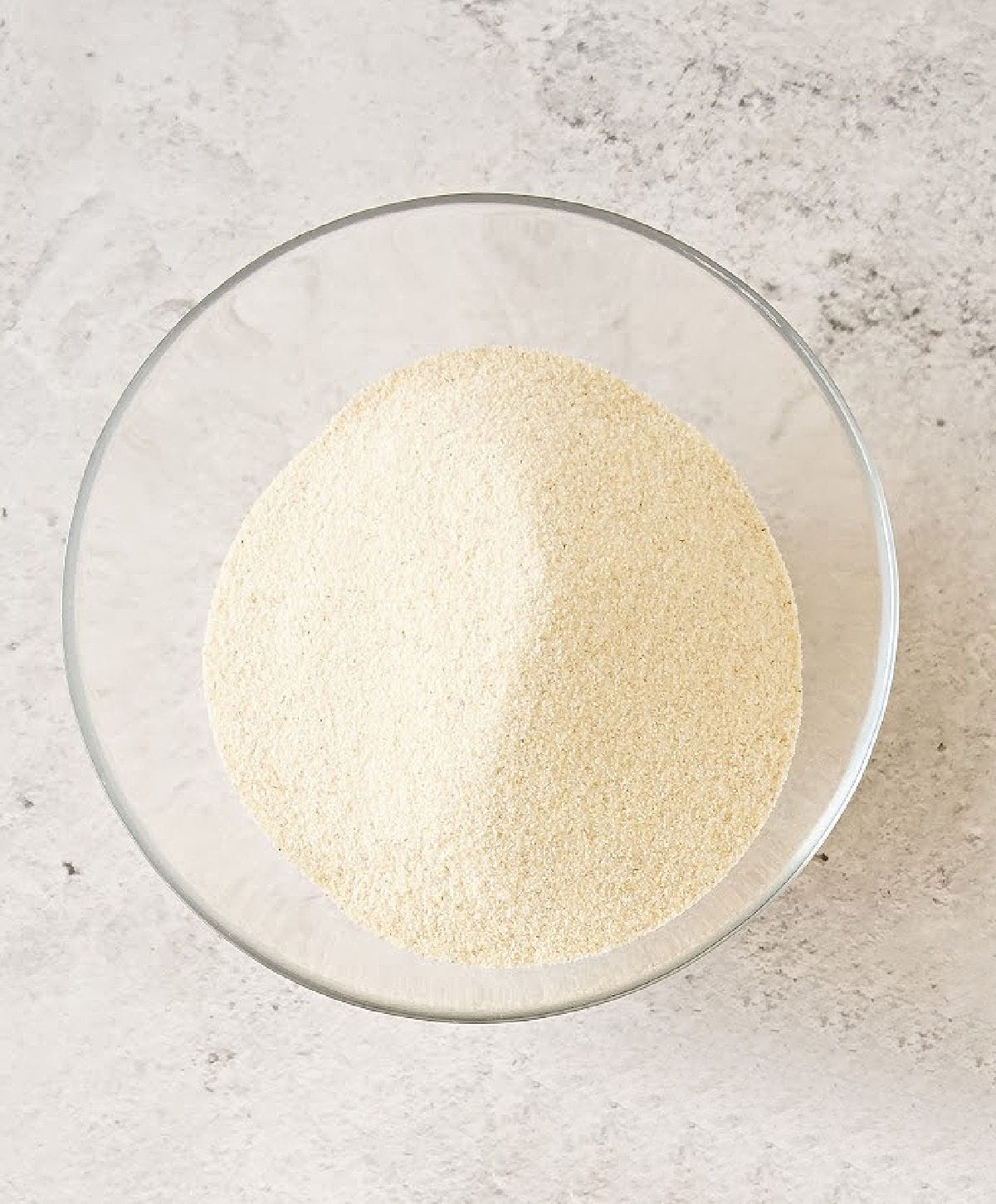
- Semolina flour: It's a fine-textured flour made from durum wheat (also used to make dried pasta). It has a nutty undertone and gives the bread a welcome golden hue. It's similar to very fine sand (image below) and different and much finer than bread flour. You need both for this bread. Semolina (semolin in some countries) comes in various textures and coarseness. Couscous, for example, is also semolina, but not at all what we need for this bread.

How to Make Sure Yeast Works
- Check expiration date: Replace if expired.
- Visual check: Should be beige to light brown and granular/powdery. Avoid if grayish, clumpy, or discolored.
- Smell test: Should have a mild, slightly sweet smell. Strong or unpleasant odors indicate it's bad.
Proofing test: Mix ½ teaspoon sugar in ¼ cup warm water (comfortable to touch). Sprinkle ½ teaspoon of dry yeast on top and stir gently. Wait 5-10 minutes until you start to see some activity. Fresh yeast will foam and bubble more while instant yeast bubbles less than active dry yeast.
Golden Rule: When in doubt, buy new! It's better to be safe than to have your baked goods fall flat and be inedible. You'll have to throw it out and start again.
Process steps
This is a fantastic recipe because it's easy to knead by hand. It is even easier with a stand mixer (using the dough hook).
Make the sponge
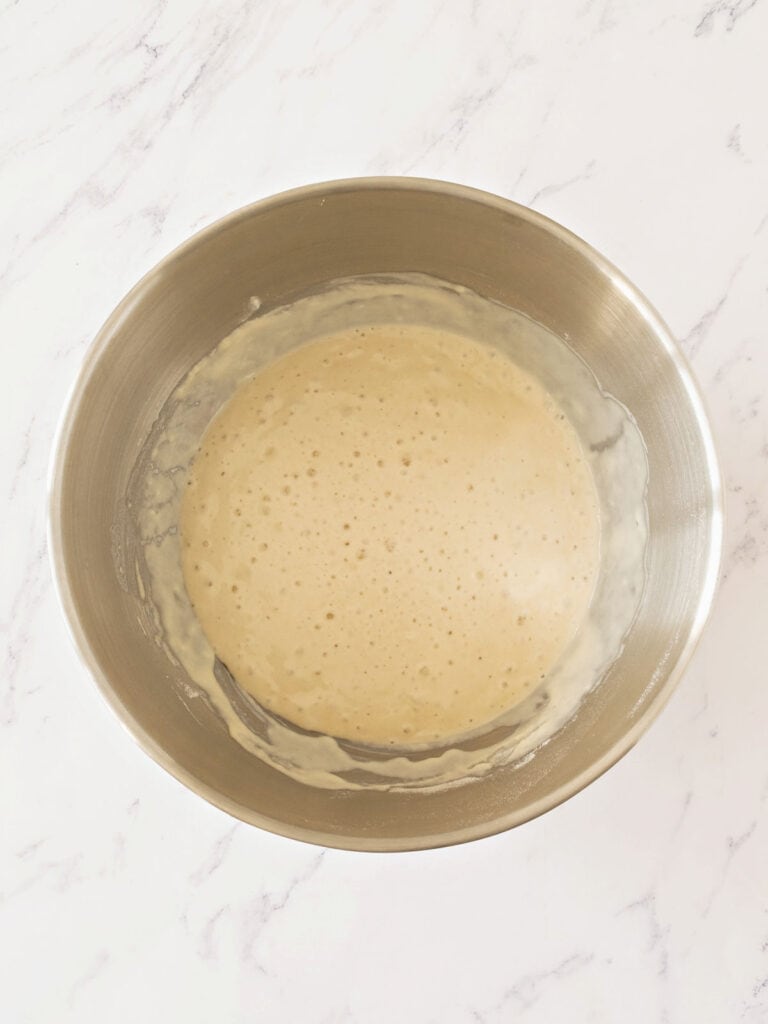
Active-dry yeast is mixed with flour and water. After resting covered for 1 hour, it will have grown, and air pockets like bubbles will have developed. If this doesn't happen, the yeast is not working. Don't go on. Buy new yeast and start again.
Kneading Bread Dough Tips
By hand:
- Use the base of your palms for better control and pressure
- Flour: Avoid adding too much; sprinkle sparingly, knead first and adjust only if needed. Let the dough absorb added flour before adding more
- Sticky doughs: Use a dough scraper to help fold and turn doughs that are hard to handle.
With a stand mixer:
- Use the dough hook attachment.
- Start on low speed, then increase to medium once the dough comes together.
- Avoid overkneading: most bread doughs, with some exceptions like brioche, need about 5-10 minutes of kneading.
- Avoid overloading the bowl; knead large recipes in batches or smaller portions. Check the capacity of your mixer, as overloading can cause the motor to burn out.
The bread dough
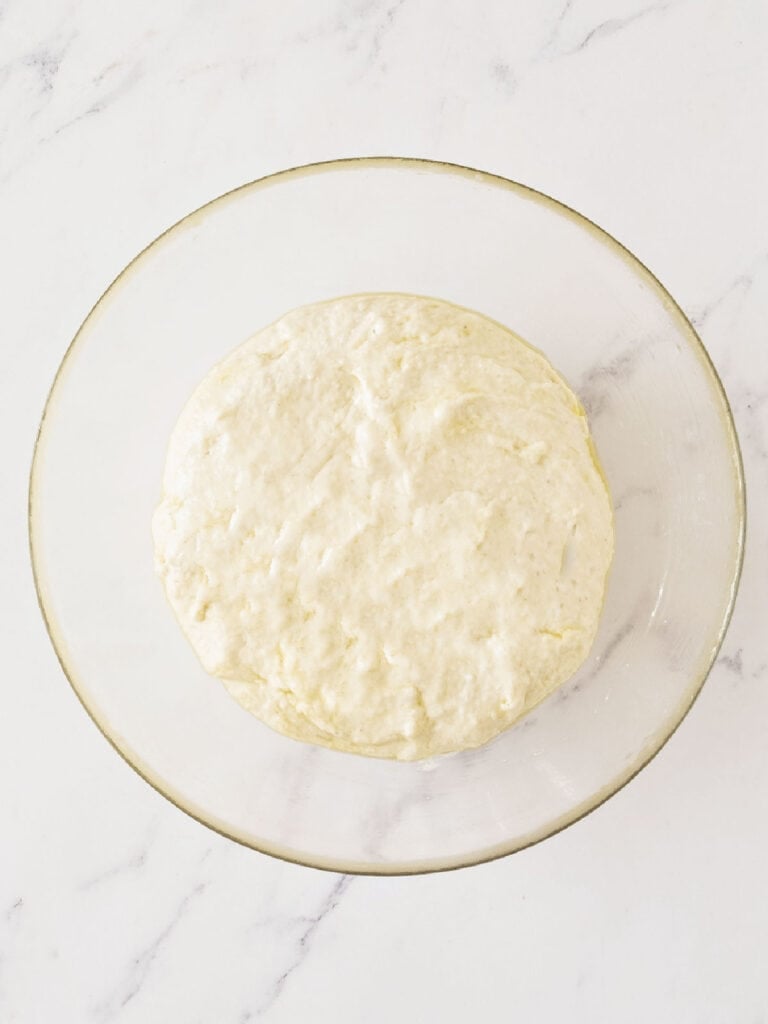
With the sponge ready, we need to add the rest of the ingredients to the yeast mixture.
It will look like there are not enough wet ingredients when you turn it out onto the counter, but the dough starts forming in no time after you start bringing it together and kneading.
After 1 or 2 minutes, the dough is rough but not sticky, and all the ingredients are combined.
How long does it take? About 10-12 minutes to knead it by hand and about 7-8 minutes with a stand mixer.
First rise
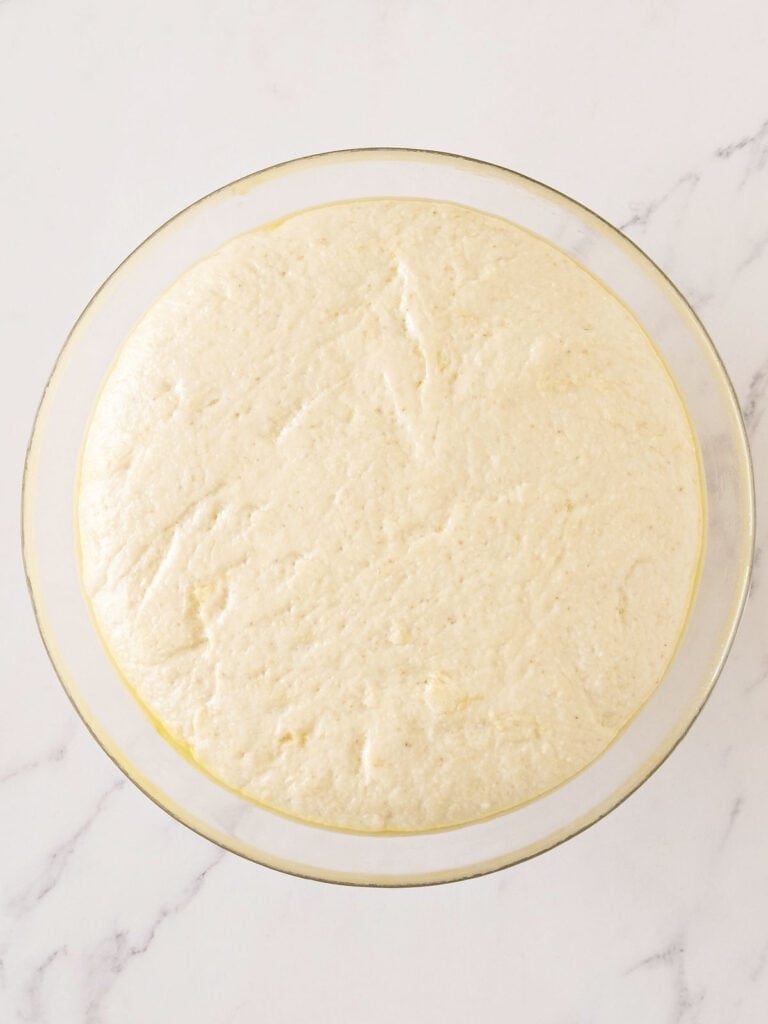
This is a crucial part of bread-making. Let the dough rise until doubled in size, which takes about 1 hour. So put it in an oiled bowl, turn it around to coat, and cover the bowl with plastic.
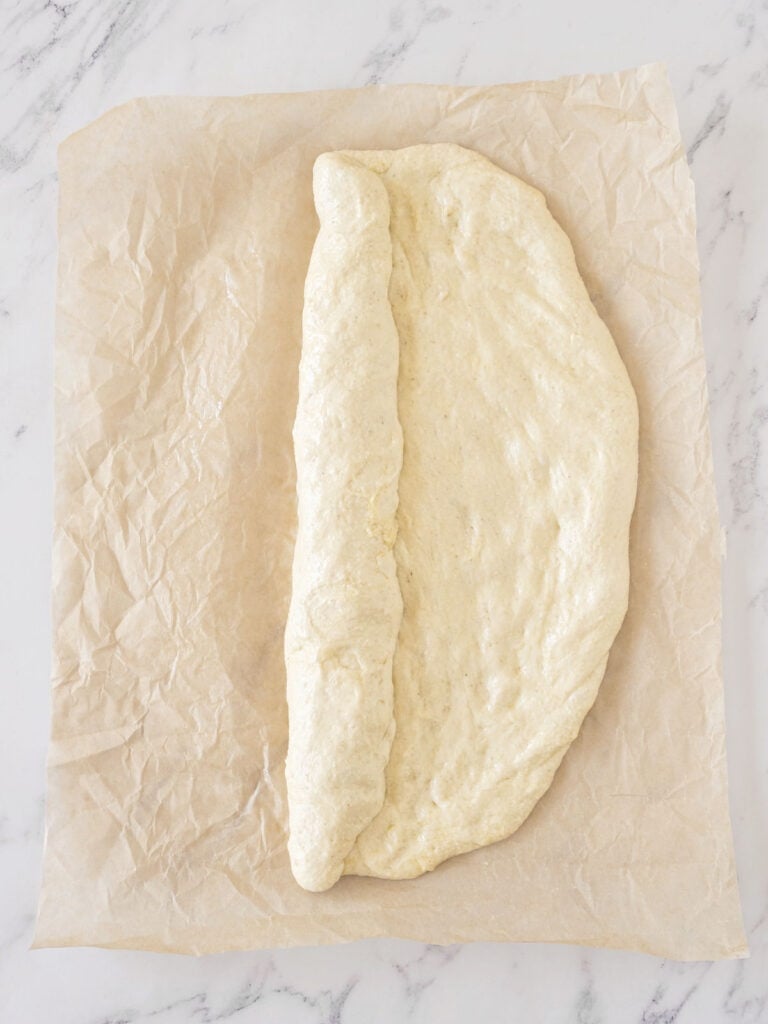
Form the loaf
The dough is supple and friendly to work with. It can be shaped differently, and I like the batard, a plump and short baguette.
Flatten the dough with your hands to make a rectangle on a piece of parchment paper or a clean countertop.
Fold it like a cinnamon roll, and pinch after each fold. Pinch and seal the whole bread to prevent it from 'unfolding or unrolling' during baking.
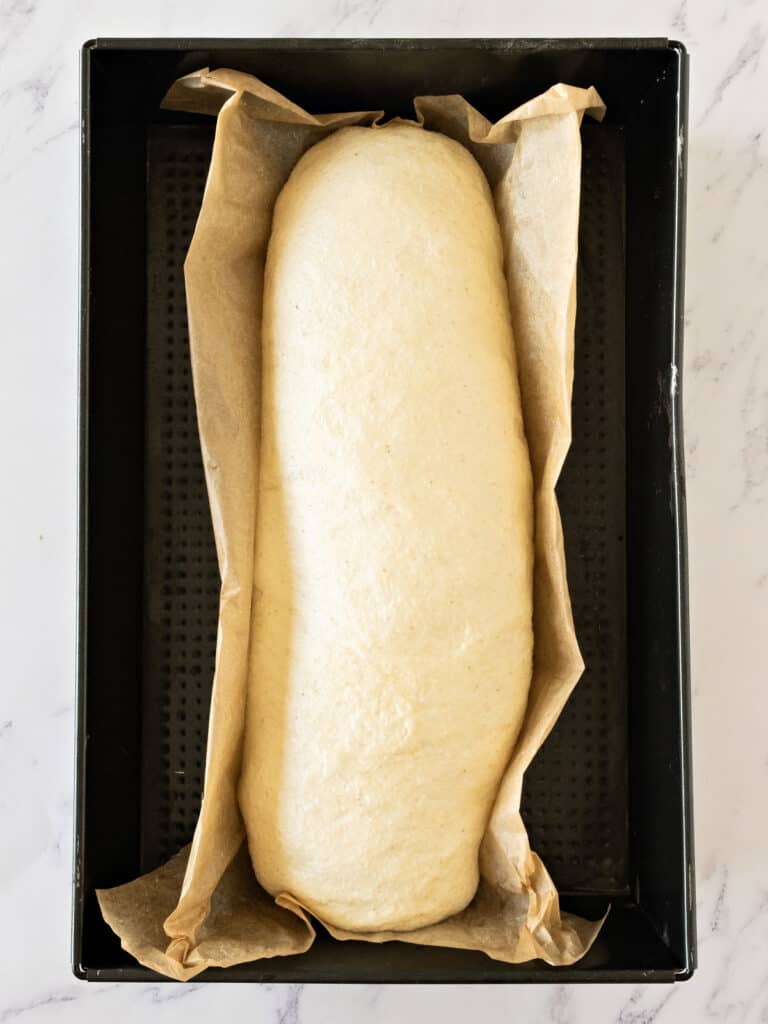
Second rise
Once shaped and on the baking sheet, the bread loaf needs a second rise. Cover it loosely with a clean kitchen towel and place it in a draft-free, warm place.
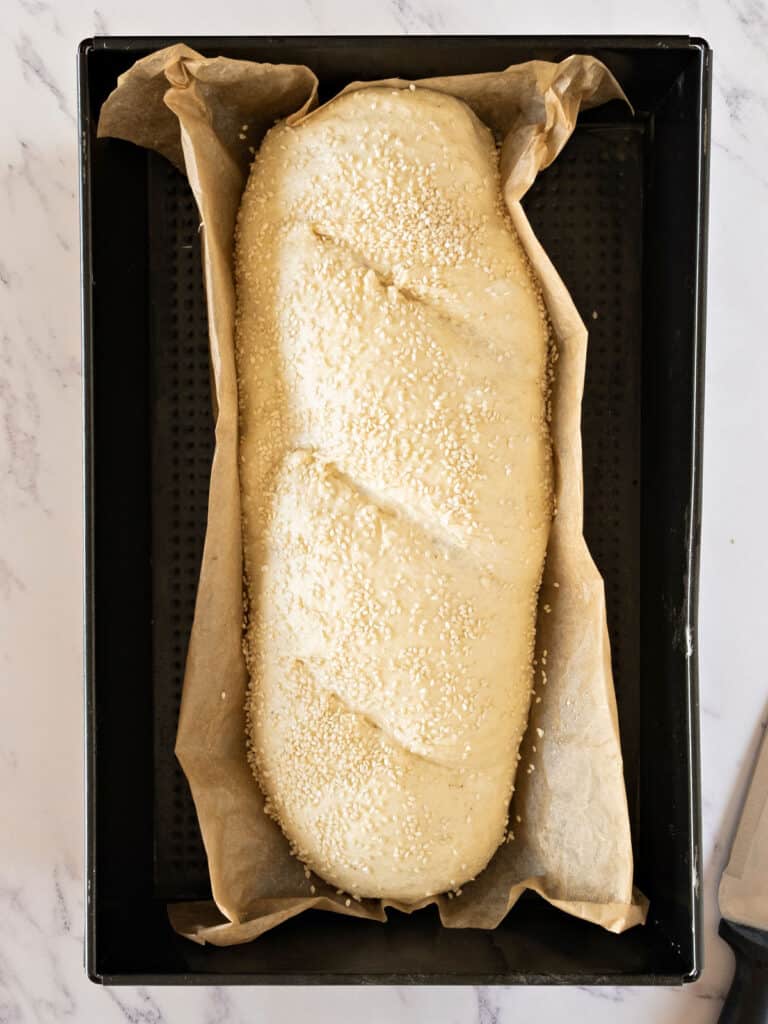
Scoring the bread
To score a loaf is to make cuts or slits right before baking it. They will allow the bread to rise better as it has a place to unfold and grow. You can use a sharp kitchen knife or a special scoring tool called a lame. It is a razor blade on a stick. It might not be a clean cut, depending on how wobbly the dough is. That is fine; be decisive and go for the cut.
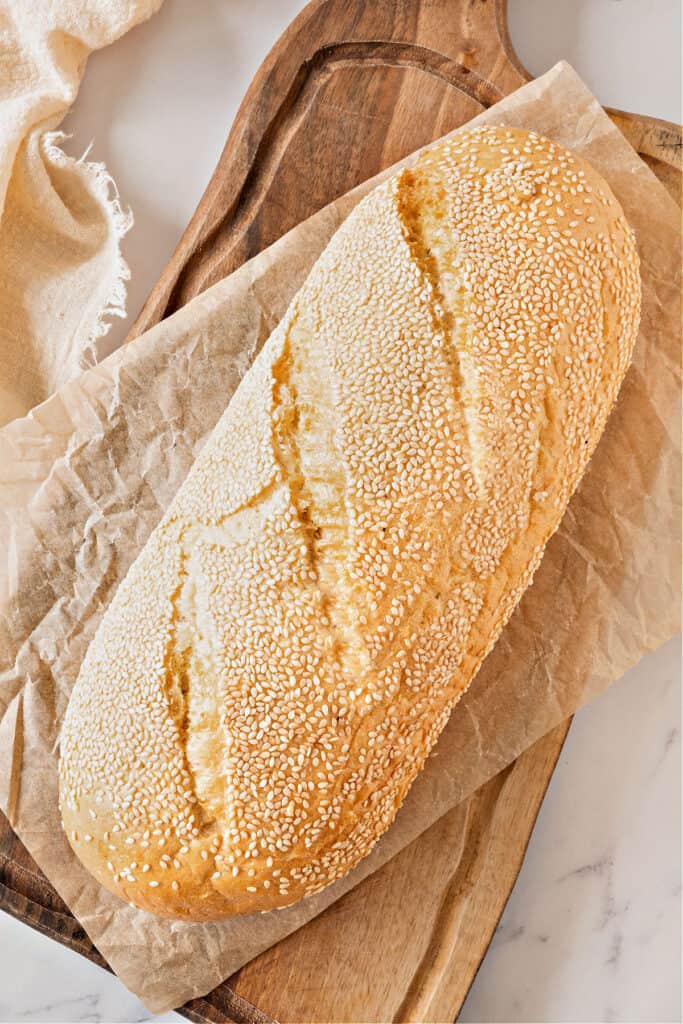
Baking
It will puff and rise beautifully, and the slits will open.
When is it ready? The crust will be dry and turn a wonderful golden hue (a characteristic of semolina flour). If you tap the bottom of the loaf lightly with the tip of your fingers or the back of a spoon, it will sound hollow.
As an Amazon Associate, I earn from qualifying purchases. Read my disclosure policy.
Best Semolina Bread
Ingredients
Sponge:
- 1 cup lukewarm water, tap is fine
- 1 teaspoon dry yeast, use 1 teaspoon active-dry yeast or ¾ teaspoon instant yeast, see Notes below
- 1 ½ cups all-purpose or bread flour, you can buy bread flour online
Dough:
- the sponge, above
- ½ cup all-purpose or bread flour, you can buy bread flour online
- ¾ cup semolina flour
- 1 to 2 teaspoons salt, If you normally don't use much salt go for the 1 teaspoon
- 2 tablespoons olive oil
Instructions
To make the sponge:
- Place 1 cup lukewarm water in a mixing bowl and whisk in 1 teaspoon dry yeast.
- Stir in 1 ½ cups all-purpose or bread flour, mix lightly and cover the bowl with plastic wrap.
- Set the sponge aside to rise at room temperature (draft-free and warm) until the sponge doubles, about 1 hour. I do this directly in the bowl of the standing mixer and then add the dough ingredients.
To make the bread:
- Have ready a baking sheet lightly dusted with semolina.
- Stir the sponge to deflate, and add ½ cup all-purpose or bread flour, ¾ cup semolina flour, 1 to 2 teaspoons salt, and 2 tablespoons olive oil.
- Adjust the bowl in your stand mixer and knead on low speed with the dough hook for about 5 minutes to form a smooth, elastic, and slightly sticky dough. Alternatively, turn the shaggy dough onto a lightly floured surface and knead by hand for about 6-7 minutes. See the post above for images and further details.
- Transfer the dough to an oiled bowl. Turn the dough, so all the sides are oiled. Cover the bowl with plastic wrap and let rise until doubled, about 1 hour.
- Turn the risen dough out on the floured work surface.
- Press with the palms of your hands to deflate.
- Shape the dough into an oval, folding as you would a cinnamon roll, pinching at the seams after each fold, and place tucked side down on the prepared pan and cover with oiled plastic wrap. I like to use parchment paper or the pan dusted with semolina.
- Allow it to rise until doubled in volume, about 1 hour. About 20 minutes before baking, turn the oven to 400ºF (200ºC).
- Sesame seeds on top: this is optional. Lightly dampen the dough on top (carefully, as you don't want to tear or deflate it) and sprinkle the seeds, pressing gently to adhere. Or transfer it carefully to a tray with sesame seeds and roll to coat (I don't recommend this if you're a beginner and not used to handling proofed loaves).
- Hold a razor blade or sharp kitchen knife at about a 30º to 45° angle to the loaf, and slash 3 lines.
- Bake the loaf for about 35 minutes until well risen, golden brown, and the bottom sounds hollow when tapped. All ovens are different, so if 20 minutes into baking you feel the bread is darkening too much, turn it down to 375°F (190°C) for the rest of the baking.
- Remove from oven and cool on a wire rack until able to lift from the baking sheet with a spatula, and wait until completely cooled to cut.
Notes
Adapted from How to Bake by Nick Malgieri

kekrry says
Could you tell me the water qty in grams as us cup size says 236g and australia cup size where I am says 250g. I found my dough very loose.
Paula Montenegro says
Hi, I convert a cup of water to 240g. Bread baking can have variations depending on the day, type of flour, etc. so adding a couple of extra tablespoons of flour is OK if you feel it needs it. Did you bake it and it didn't turn out right?
kekrry says
Thanks Paula yes it did, definitely will give it a go with 240g water as my water amount was larger. Bread was still tasty but hoping for a better oven spring with a better shaped loaf. Thankyou for your prompt reply.
Sandy Vartorella says
Hi, Paula - Thanks for sharing what looks to be a great recipe; will be trying it soon. Just wondering about subbing 100% whole wheat flour for SOME of the all-purpose or bread flour...have you tried that and do you have any suggestions?
Thank you.
Paula Montenegro says
Hi Sandy! I haven't tried but there's a whole wheat flour that's superfine and is very similar in texture to white flour. I have great results with it and think you should have no problem swapping it in this recipe.
Sandy Vartorella says
Thanks very much!
Michael says
New standby for us; thanks! It's a buttery, soft Italian bread with a great crust. Absolutely fantastic toast, too. I quadruple the recipe and make it in our Bosch Kitchen Machine.
Paula Montenegro says
SO happy you left this comment Michael! It's great to know the recipes work and that they become staples. Have a great day!
Laresa J Flake says
I've been working on this recipe today and I let the sponge rise, then added the flour/semolina as per the instructions. I'm currently waiting on the first actual rise after adding the flour and it's been an hour and 20 minutes and it barely looks to have risen at all. As my house is very cold, I have it in my oven on "bread proof". What did I do wrong?
Paula Montenegro says
Hi Laresa, if it's in a warm environment it should rise. I literally wrap it in blankets when the room is too cold. Were you able to bake it?
Kolaylezzet says
The quality o semolina is very important, I think...
suzi says
made this afternoon. delicious but the time i put into it does not equal the time it quickly disappears! can i double the recipe and separate the dough at the end of all the rising before shaping, scoring and baking?
Paula Montenegro says
Haha, so true Suzi! You can double it. If you're using a standing mixer make sure it can hold all of the dough, and if kneading by hand it will take a few more minutes. You then make two loaves.
Elli says
Hey thanks for the recipe I made this bread few days ago and all the members of the family absolutely loved it. I just have one question is it possible to let it rise overnight in the fridge after I mad and transferred the dough to an oiled bowl?
Paula Montenegro says
Hi Elli, so happy you all loved it! You can leave it to rise overnight. I don't have specifics about how many hours and other details because I haven't tried it recently, but I will do so today as so many have asked the same question. Pop it in the fridge before the last rise, well covered but with enough some space for it to grow (a deep bowl for example). It will take a couple of hours to go back to room t° before you can go on with the recipe.
Patricia says
Easy recipe! Is using instant yeast as asked previously: should we use the same quantity? (1 tsp of instant yeast)? Thanks 🙂
Paula Montenegro says
Hi Patricia, as long as it's dry yeast it is the same amount. And when making the sponge mix the instant yeast with the flour and then add the water. Let it rise and follow the rest of the recipe as instructed.
Patricia says
Hola! Muchisimas gracias por tu rapida respuesta! Es la primera vez en mis 41 anos que le perdi miedo a hacer pan, y este de semolina me quedo super bueno y se ve super presentable. Habia tratado por mucho tiempo pero el “fear of failure” me ganaba, y los resultados eran espantosos, ja ja!
Ahora con tus recetas practicare mas. Practice makes perfect 🙂
Buenos noches desde Singapore!
Paula Montenegro says
Ay cuánto me alegro Patricia! La realidad es que todos mejoramos con la práctica. Vamos por más panes!
Sharon M says
I made this bread today and we had meatball hoagies for dinner. I am new to breadmaking and the instruction were easy to follow and understandable.
I plan on baking a few loaves this week for my neighhbors. Thank you for a wonderful recipe.
Paula Montenegro says
Thank YOU for the comment Sharon. It's great to know when a recipe works well! Have a great week.
Mignon from Texas says
This was my first time making bread today. Wow! This is amazing bread! Thank you for the recipe!
Do you know if adding cheese and jalapeños would work between the rolls or would it not bake correctly?
Paula Montenegro says
Oh, thank you Mignon! I'm so happy when it works! I think cheese and jalapeños would work well. Don't add too much the first time to see how it goes, you don't want the filling to add too much moisture that the bread doesn't bake well.
Maude Muto says
How to alter recipe using instant dry yeast please?
Paula Montenegro says
Hi Maude, when making the sponge mix the instant yeast with the flour and then add the water. Let it rise and follow the rest of the recipe as instructed. Enjoy the weekend!
El says
Hello 🙂 how long is the second rising supposed to be? Many thanks,
El says
I found the part on the page which specifies the 2nd rise time 🙂 (the 1st part at the top didn't say)
The bread had come out great! Thank you so much!
Paula Montenegro says
Hi El! Glad it came out great. The first rise is the sponge, then another rise with the whole dough, and then the formed loaves rise again before baking. It needs to double the first two times and that takes about 1 hour each rise.
vincent winkleblech says
We love this recipe Paula s much. i have a question to ask though. Can i make a single batch and refrigerate for 24 hours as a Prefermented Dough? then the next day make another batch to combine with the preferment? i am not sure how the Semolina would act as part of the Prefermenting process.... All i know is my wife and 3 boys sing praises and constantly bug me to make it 3X a week !!!!
Paula Montenegro says
Hi Vincent, glad they all like it so much! My experience is that the formed loaves can be refrigerated overnight (oiled tops and lightly covered as they will need room to grow). If they haven't grown too much after that time (it happens sometimes if the fridge is not cold enough) leaving them another 12 hours should not be a problem. You can always try with a bit of dough the next time you make it to see how it goes. Let me know if you have any other issues! Have a great week.
Nina says
This recipe was so delicious and my end product looks just like the pictures. I would reccommend anyone to try their hand on this bread.
Paula Montenegro says
Oh thanks so much Nina, and I'm glad you liked it!
Rachel Robertson says
Worked really well and was delicious. Thank you.
Kerry Partridge says
Turned out fantastic, thank you. I'm in lockdown in Italia, a rainy day so gave it a go. Used Italian Manitoba flour and the semola. Used 1 teaspoon of salt and also used fresh yeast (lievito di birra) so doubled the amount mentioned for dry. It has barely cooled and me and the wife have had quite a bit of it already! Thanks again.
Kerry
Paula Montenegro says
So glad you all liked it, especially coming from Italy! I usually triple when using fresh yeast, but good to know it works with only double the amount. Have a safe week!
Kerry says
Thank you, I'm going to try it with grano tenero tipo '0' as the manitoba is sometimes a bit more difficult to get hold of, especially with our restrictions on movement atm. I'll try the triple amount of fresh yeast.
Emma Doe says
This is a really easy recipe to follow, but I think I would add a less salt next time. I used 1.5 teaspoons but would probably dial it down to 0.5 teaspoons. Still quite delicious though. Thanks for sharing.
Paula Montenegro says
Glad you liked it Emma! Salt is very personal and I'll add a note in the recipe about it. Have a great Sunday!
Chin says
It's my first attempt at bread making and your recipe was so easy to follow. I love the texture and the taste of the bread. The temperature was a bit high though. Had to reduce to 190°C after baking halfway. And I'd reduce the salt next time. Overall, it's a great recipe. Love it!
Paula Montenegro says
Glad you liked it Chin! All ovens are different, thanks for the comment. I added a note in the recipe to be aware of that. Have a great weekend!
Mary says
I am new to bread making and making this bread for the first time. Do you proof the dough in a steamy oven at any point?
Paula Montenegro says
Hi Mary, no, I don't. I proof it covered only. Sometimes I cover it with a blanket if the room is too cold. I used to add some steam to the oven to get a better crust, and you can do that. Spray the oven with some water as you're putting the bread, and immediately close the door.
Sammi says
Does this work with rapid rise yeast
Paula Montenegro says
Yes, it does. For the sponge, simply mix the flour with the yeast (it doesn't need hydration like the active dry), add the water and let it rise as instructed in the recipe. The amount is the same.
Suzi says
Coooooling. So excited